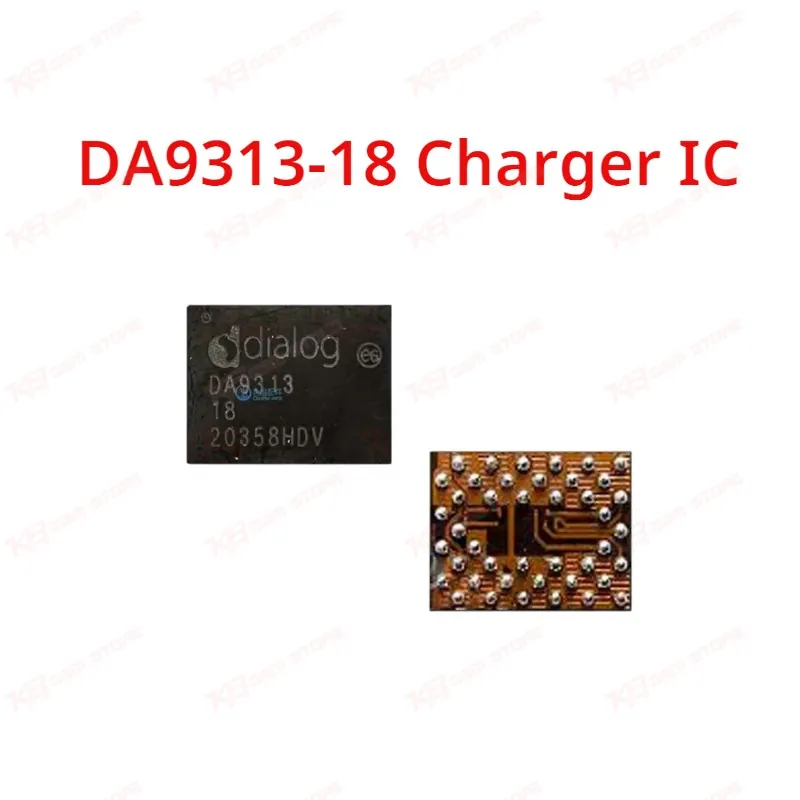
The DA9313-18 sits directly in the charging power path on Oppo Reno4 Pro, Realme 7 Pro, and OnePlus 9R motherboards, and its job comes down to one core function: cutting the incoming charger voltage roughly in half before it reaches the battery cell. Dialog Semiconductor built this chip as a switched-capacitor 2:1 divider rather than a traditional linear regulator, so instead of burning off excess voltage as heat, it moves charge between internal capacitor banks to step a 5V–10.5V input down to about half that value at the output. You feel this design choice directly on your bench — boards running this IC stay noticeably cooler under fast-charge loads than boards using older linear charging stages, and Dialog rates the conversion efficiency at up to 98%, wasting very little power as heat during a charging cycle.For a working technician, this matters most when a customer brings in a dead phone that charges slowly, won't charge past a certain percentage, or heats up fast the moment you plug in a cable. Trace the fault to the power stage and you're usually looking at this IC, a shorted inductor, or a damaged filter capacitor sitting right next to it. Because the DA9313-18 draws its input from the same fast-charge rail the connector feeds, a board that shows normal voltage at the connector but drops or fluctuates right after the IC almost always points to this part, not the charging port itself.Reballing and swapping this IC calls for the same discipline you'd apply to any BGA-package power chip. Set your hot air station in the 320–350°C range with airflow low enough to avoid shifting nearby components, lift the old IC clean without dragging pads, clean the footprint with flux and braid before reballing, then align the new DA9313-18 under a microscope before reflow. Rushing the reflow stage causes most repeat visits — an underheated joint on this IC gives you exactly the symptom you started with: fake charging shown on screen, charging that drops out after a few minutes, or a battery percentage that never moves.On the diagnostic side, put your bench power supply across the battery test points before you commit to an IC change. A board that pulls current steadily but never ticks up in voltage usually means the divider stage failed internally rather than the battery cell going bad. A board that pulls no current at all, or trips your supply's overcurrent protection instantly, points toward a short on the output side — check the inductor and nearby capacitors before you blame the IC. This sequence saves you from reballing a chip that was never the actual fault, the single biggest time cost on any dead-after-flash or non-charging job.Because this IC ships as a genuine Dialog Semiconductor part rather than a generic clone, it matches the original footprint, pinout, and electrical behavior of the factory-installed chip on Reno4 Pro, Realme 7 Pro, Realme Q2 Pro, Reno5 Pro, and OnePlus 9R boards, so you don't need to adjust your reflow profile between the original part and this replacement.Store this IC in an anti-static tray until you're ready to reflow it — switched-capacitor dividers like this one carry ESD-sensitive internal structures, and a static discharge across the pads before soldering can weaken the part before it even sees a board. If you run a service center handling volume Oppo and Realme charging complaints, keep more than one unit in stock: charging port wear, low-quality chargers, and moisture exposure are common causes of repeat charging faults on this chipset family in the Pakistani repair market, so a single unit rarely covers a busy week's workload.