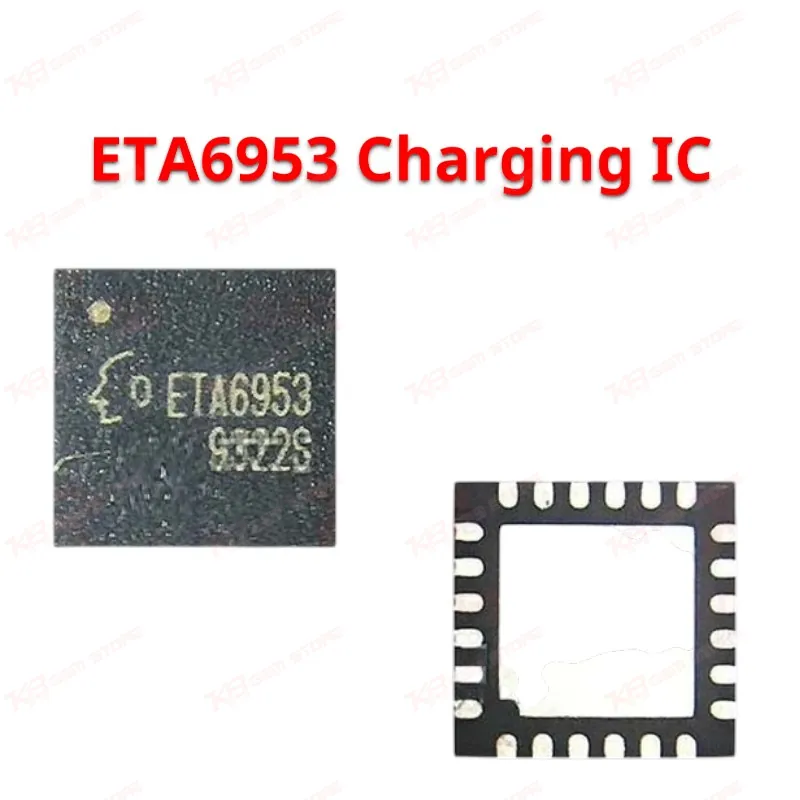
When a Redmi or POCO board comes in with a charging issue, slow charging, or a "battery not increasing" complaint, the ETA6953 charging IC is one of the first components a technician checks. This chip sits at the heart of the phone's power path, managing everything from input detection to battery charge termination, so a fault here shows up immediately as a charging problem, power detection fault, or overheating symptom on the bench.The ETA6953 is an I2C-controlled 1-cell battery charger from ETA Solutions, rated for 13.5V input and 3.0A charge current. It's a highly integrated switch-mode charge management IC, meaning it packs the input reverse-blocking FET (Q1), high-side switching FET (Q2), low-side switching FET (Q3), and battery FET (Q4) into a single QFN4x4-24 package. For a repair bench, this integration matters because it reduces the number of discrete components around the charging circuit, and it's also why a single IC failure can take down the whole charging path.On the input side, the chip accepts a wide voltage range from 3.9V up to 13.5V, with a 30V absolute maximum rating, and supports both standard USB ports and high-voltage adapters through its PSEL pin for input current selection. It runs a 1.5MHz synchronous buck converter and hits 90% charge efficiency at 2A from a 5V input, which keeps heat down during fast charging sessions — useful to know when you're troubleshooting a board that's charging but running hot.Charge current is programmable from 0 to 3000mA in 60mA steps, and charge voltage regulates between 3.856V and 4.624V, with a default termination voltage around 4.208V. The IC also includes a boost/OTG mode, outputting up to 1.2A at 5.15V by default, so if a board fails to power external USB devices or fails OTG detection, this chip is worth checking as well.Communication with the host processor happens over I2C at slave address 0xD6, supporting both standard (100kHz) and fast (400kHz) modes. When the host isn't actively managing the chip, it falls back to a default autonomous charging mode with a built-in 10-hour safety timer, so charging still works even without full software control — this is why some boards still show partial charging behavior even when there's a software-side fault.Protection features built into the ETA6953 include input overvoltage protection, thermal regulation starting at 110°C, thermal shutdown at 160°C, battery overvoltage protection, and battery over-discharge protection with automatic BATFET cutoff. It also supports JEITA temperature profiles through a dedicated TS pin, adjusting charge current and voltage automatically based on battery temperature — a detail that matters if you're seeing charging drop off only when the phone gets warm.For board-level repair, this IC change is a common fix on Redmi 9A, Redmi 9C, and Redmi Note 9 boards where the phone shows dead after flash, hang on logo tied to power sequencing, or a "charging not increasing" fault that survives a battery swap. Since the chip handles both the charge path and the system power path, a faulty ETA6953 can also cause boot loop symptoms if the system rail can't stabilize during power-up. Reflow with hot air and proper preheat, confirm ground continuity on the thermal pad after mounting, and check I2C lines for shorts before assuming the IC itself is bad, since SDA/SCL issues on the host side can mimic a dead charging IC.