


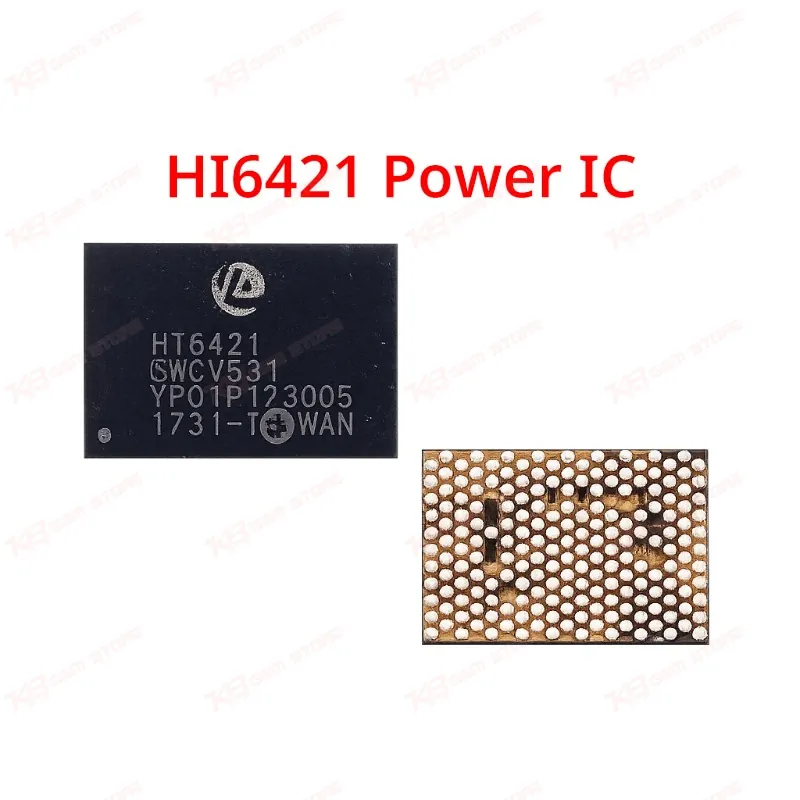
HI6421 Power IC
HI6421 Power IC
Regular price
Rs.450.00 PKR
Regular price
Sale price
Rs.450.00 PKR
Shipping calculated at checkout.
Quantity
Couldn't load pickup availability
The HI6421 Power IC is a HiSilicon power management BGA chip used across the Huawei Mate, P-series, and Honor lineup to regulate battery charging, voltage output, and overall power distribution. When a phone shows dead after flash, no power on, or unstable charging issue, this IC is often the root cause. Every HI6421 chip at KB GSM Store is tested before dispatch, giving technicians a reliable option for board-level power IC replacement on the repair bench. Suitable for shops running Mate 7, Mate 8, Mate 9, P8, P9, P20 Pro, and Honor 6/8 repair jobs on a regular basis.
⚖️ Weight: 0.01 kg
SKU:MST-IC-108
- Safe & Secure Payment
- Fast Delivery
- WhatsApp Support


Description
FAQ
What is the product name?
The product name is the HI6421 Power Management IC.
What is the brand of this product?
The brand of this product is HiSilicon, Huawei's in-house chip division.
What is the model of this product?
This listing covers the HI6421 series, including GWC and GFC variants and revisions such as V610, V710, V530, V810, V910, and V310.
What is this product used for?
This IC is used to replace a faulty power management chip on Huawei boards, resolving dead phone, no power on, and charging-related faults.
Which devices are compatible with this product?
It is compatible with Huawei Mate 7, Mate 8, Mate 9, P8, P9, P20 Pro, and Honor 6, Honor 8, depending on the exact variant matched to your board.
Who should use this product?
This product is suitable for mobile repair technicians, repair shops, service centers, and professional GSM technicians.
Does the HI6421 code need to match exactly between board revisions?
Yes — Huawei changed the HI6421 variant across device generations, so you should match the code printed on your board's original chip (such as V610 or V710) before reballing.
Can a bad HI6421 IC cause a phone to hang on logo after flashing?
Yes — a stressed or damaged power rail from this IC can leave a device stuck on logo even after a successful flash, since unstable voltage disrupts normal boot sequencing.