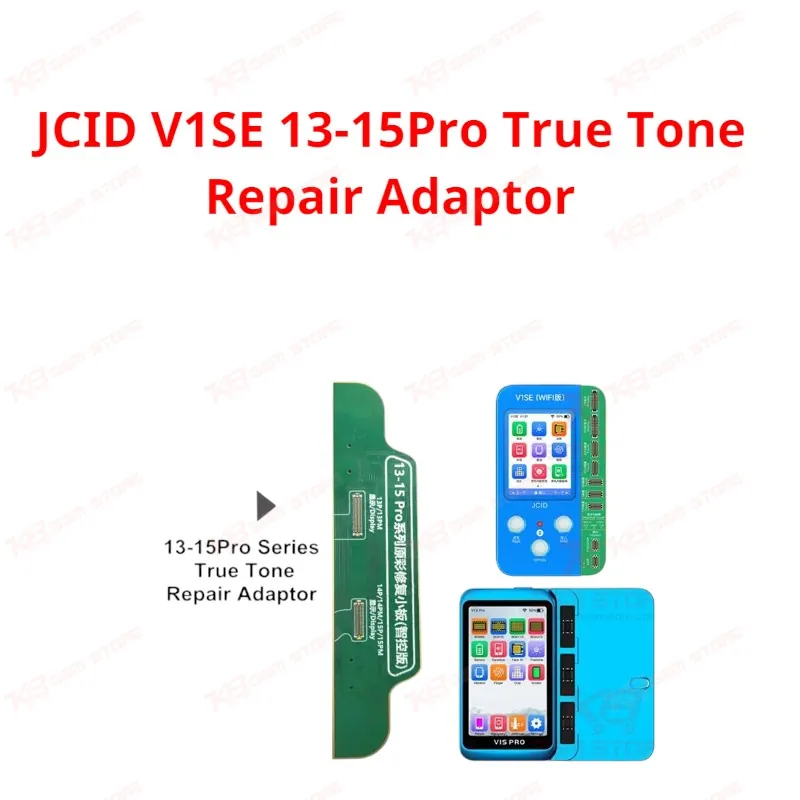
When a customer brings in an iPhone 14 Pro Max with a fresh screen but a washed-out, cold display, you're looking at a classic True Tone mismatch — not a hardware fault. The JCID V1SE True Tone Repair Adaptor exists to fix exactly this scenario. It plugs into your JCID V1SE or V1S Pro programmer and gives you direct read/write access to the display IC's cover code, which is what controls True Tone verification on the 13 Pro, 13 Pro Max, 14 Pro, and 14 Pro Max models. On these units, the check happens at the display IC level, so you only need to write the cover code — you don't touch the touch IC data, and that matters because modifying touch IC data unnecessarily is what causes pop-up window errors after reassembly. This adaptor covers the full Pro line from the 13 series through the 15 Pro Max, which means one board handles three generations of True Tone repair instead of forcing you to stock separate adaptors per model year. That's a real bench-space and inventory saver for a repair shop running multiple iPhone jobs a day. Working with original screens is straightforward — you read the data, write it to the new panel, and the display picks up the correct color temperature response to ambient light. Aftermarket and copy screens, including boards using Samsung and LG panel sourcing, are also supported, which covers the reality of what's actually available in the Pakistani parts market where OEM-only isn't always practical. Keep one thing in mind on the display IC side: write cycles are typically limited to 3–5 attempts. If a write fails repeatedly, don't keep forcing it — you risk damaging the screen. Touch IC data, by contrast, has no such write limit, so where a repair touches that path there's more room to retry safely. This tool sits squarely inside the diagnostics and flashing stage of your repair workflow. After screen replacement, before you hand the phone back, this is the step that closes the loop between hardware repair and software verification — it's the difference between a customer thinking you did a professional job or thinking you cut corners on a cheap-panel install. For technicians running JCID box tools across the bench, this adaptor fits directly into that same "box chalana" routine you already use for other iPhone data recovery tasks — no separate software marna step needed, since it works through the existing V1SE/V1S Pro interface. Build quality is a flat, compact board designed for direct connection without adapters or extra cabling, so setup time between jobs stays minimal. For a service center processing high volumes of screen replacement tickets, that turnaround speed adds up across a working day. Whether you're clearing a True Tone warning on a customer's own screen or verifying a batch of refurbished panels before they go back into stock, this adaptor keeps that specific repair problem cluster — True Tone loss, display IC mismatch, screen replacement verification — inside one dependable tool rather than spread across multiple workarounds.