Skip to product information
1 of 5

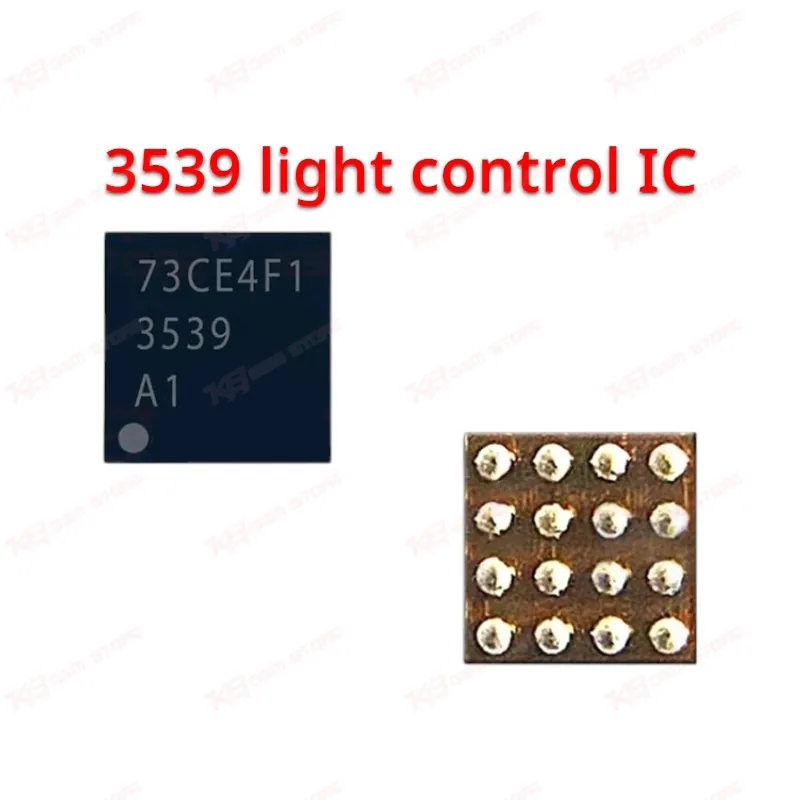
LM3539 light control IC

LM3539 light control IC

Regular price Rs.180.00 PKR
Regular price Sale price Rs.180.00 PKR
Sale Sold out
Shipping calculated at checkout.
Quantity

The LM3539 backlight driver IC — board-marked U4020, U4050, U3701, U4601, U5650, or U5660 depending on the device — controls display backlight boost and dimming on iPhone SE, 6S, 6S Plus, 7, 7 Plus, 8, and 8 Plus logic boards. Technicians use this chip to fix dead backlight, dim display, or backlight flicker after liquid damage or drop faults. You get a genuine Texas Instruments "MUON" series driver built for board-level microsoldering replacement on your repair bench, not a generic clone part sold without proper part-number verification.

⚖️ Weight: 0.01 kg

SKU:MST-IC-338

  • Safe & Secure Payment
  • Fast Delivery
  • WhatsApp Support
View full details

Description

When a customer brings in an iPhone with a black screen but a working touch response and audio, your first suspect on the repair bench should be the backlight driver, not the display assembly itself. The LM3539 is exactly that component — a Texas Instruments "MUON" series LED backlight driver IC that generates the DC boost voltage for the LED anode and drives two PWM-controlled cathode channels feeding the display's backlight LED string.You find this IC soldered directly onto the logic board rather than inside the screen assembly, which is why swapping the display alone rarely fixes a true backlight fault. On iPhone SE and 6S boards it carries the label U4020, on 6S Plus boards either U4020 or U4050, on iPhone 7 and 7 Plus boards U3701 or U4601, and on iPhone 8 and 8 Plus boards U5650 or U5660. Knowing the correct board designation before you order or reball a replacement saves you from mismatched parts and wasted rework time.In real workshop conditions, this IC gets damaged mostly from liquid ingress, a drop that stresses the solder balls, or a short somewhere downstream on the backlight boost line that eventually cooks the driver. Common symptoms on your bench include a completely dead backlight with the phone otherwise responsive, a display that lights up dim and never reaches full brightness, backlight flicker that comes and goes with movement or temperature, or backlight that works briefly then cuts out. Before you commit to changing the IC, always check the boost inductor, the associated capacitors, and continuity to the display connector — a large share of "dead backlight" complaints trace back to a cracked boost coil or a lifted pad rather than the driver chip itself.This part comes in a compact 16-pin package, so removing and reballing it is a microsoldering job, not a hand-soldering one. You'll need hot air, a good microscope or magnification setup, flux, and either a stencil or manual reballing technique to reattach it cleanly. Reflow temperature control matters here — overheating the pads next to this IC risks lifting neighboring components on a densely packed board.Chipset-wise, this driver works alongside the Apple application processor and PMIC on each of these boards but functions independently as a dedicated LED backlight boost stage — it doesn't carry any baseband or software-side dependency, so a backlight fault traced to this IC is a hardware fault, not something you'll fix with a software marna approach or a full restore. If you've already ruled out the flex cable, the display itself, and the boost inductor, and you're still seeing no backlight or unstable brightness, replacing this IC is the next logical step in your diagnostic workflow.Stocking genuine LM3539 units with verified part markings protects you from board-level rework failures caused by counterfeit or mismarked backlight ICs, which are common in the open component market. Pair this component with a reliable hot air station and a fine-tip soldering iron from your existing bench setup, and cross-check the board designation against the specific iPhone model before starting the reball, since U4020 and U4050 positions are not interchangeable across all board revisions.

Key Features

Genuine Texas Instruments "MUON" series backlight driver IC

Generates DC boost voltage for the LED anode line

Drives two independent PWM-controlled cathode channels

Supports an alternate boost route for higher LED current demand

Fixes dead backlight and dim display faults across six iPhone models

Compact 16-pin package suited for direct board-level reballing

Verified part markings prevent counterfeit-IC rework failures

Works independently of baseband and software layers — a pure hardware fix

Specifications

Brand Entity Texas Instruments
Product Entity LM3539 Backlight Driver IC
Technology Entity LED Boost Driver, PWM Dimming Control
Compatible Device Entities iPhone SE, iPhone 6S, iPhone 6S Plus, iPhone 7, iPhone 7 Plus, iPhone 8, iPhone 8 Plus
Repair Process Entity Board-Level Microsoldering, IC Reballing, Backlight Diagnostics
Industry Entity Mobile Repair Industry, GSM Technician Workshops Pakistan

Compatible Devices

iPhone SE, iPhone 6S, iPhone 6S Plus, iPhone 7, iPhone 7 Plus, iPhone 8, iPhone 8 Plus — board designations U4020, U4050, U3701, U4601, U5650, U5660 depending on model

Common Repair Uses

Backlight dead or no-backlight fault repair, dim display brightness correction, backlight flicker troubleshooting, board-level microsoldering replacement after liquid damage or drop-related short, boost line diagnostics on iPhone logic boards

FAQ

What is the product name?
The product name is LM3539 Backlight Driver IC.
What is the brand of this product?
The brand of this product is Texas Instruments.
What is the model of this product?
The model of this product is LM3539A0YFFR / LM3539A1.
What is this product used for?
This product controls LED backlight boost voltage and PWM dimming on affected iPhone logic boards.
Which devices are compatible with this product?
This product is compatible with iPhone SE, 6S, 6S Plus, 7, 7 Plus, 8, and 8 Plus under board labels U4020, U4050, U3701, U4601, U5650, or U5660.
Who should use this product?
This product is suitable for mobile repair technicians, repair shops, service centers, and professional microsoldering technicians.
Does replacing this IC fix a dim backlight if the boost inductor is also damaged?
No — you should test and, if needed, replace the boost inductor and its capacitors first, since a faulty inductor alone causes the same dim-backlight symptom without the IC being at fault.
Is a hot air station enough to reball this IC, or do you need a stencil?
A hot air station with flux and either a stencil or careful manual reballing works, but the 16-pin package requires magnification and precise temperature control to avoid lifting neighboring board components.

Ask any Query