


LN8000 Charging IC
LN8000 Charging IC
Regular price
Rs.350.00 PKR
Regular price
Sale price
Rs.350.00 PKR
Shipping calculated at checkout.
Quantity
Couldn't load pickup availability
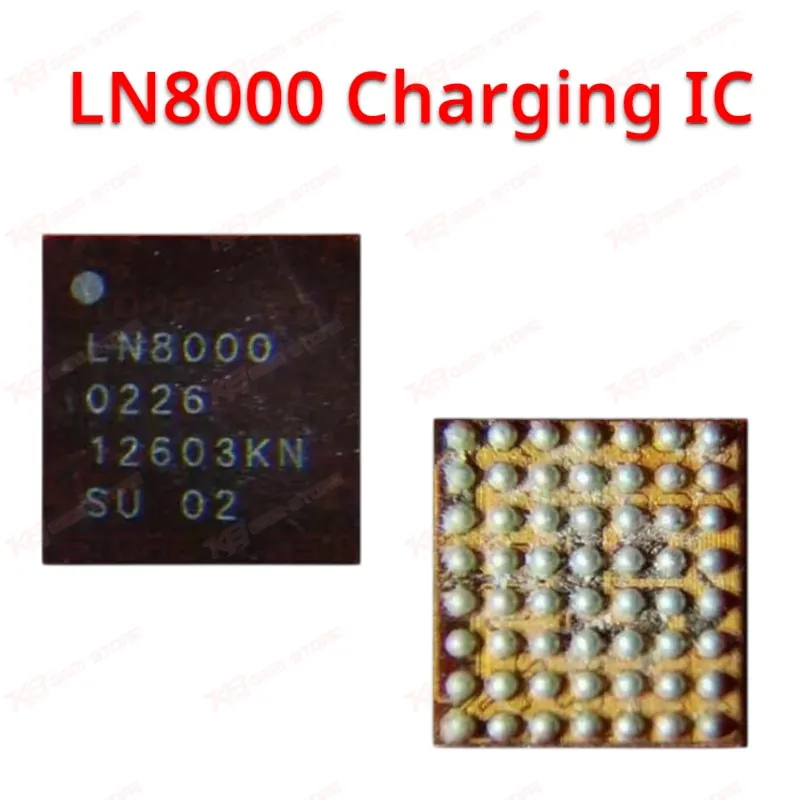
The LN8000 is an original Cirrus Logic master charger IC, the chip your board actually leans on for charging control. Technicians reach for it when a phone shows charging on screen but the percentage never climbs, when charging cuts off randomly, or when the handset runs hot the moment you plug it in. It ships in a 56-pin BGA package and handles high-efficiency 8A charging on supported boards. This IC drops onto genuine footprints for Xiaomi NOTE 11 PRO, POCO F4, REDMI K40S, and Vivo Y35, V23, V25 boards, among others. Stock it next to your reballing kit — it's a fast-moving part on any GSM repair bench.
⚖️ Weight: 0.01 kg
SKU:MST-IC-270
- Safe & Secure Payment
- Fast Delivery
- WhatsApp Support


Description
FAQ
What is the product name?
The product name is LN8000 Charging IC.
What is the brand of this product?
The brand of this product is Cirrus Logic.
What is the model of this product?
The model is LN8000.
What is this product used for?
This IC controls charging current and power detection between the charging port and battery on supported Xiaomi and Vivo boards.
Which devices are compatible with this product?
It's verified for Xiaomi NOTE 11 PRO, POCO F4, POCO F5, POCO X5 PRO, REDMI K40S, NOTE 12 PRO, and Vivo Y35, V23, V25, V25E, V27 5G, Y27, Y36, S10, S12.
Who should use this product?
Mobile repair technicians, GSM software technicians, repair shops, and service centers doing board-level charging repairs.
Which charging current does the LN8000 support?
The LN8000 is rated for high-efficiency 8A charging, which is why it appears on fast-charging Xiaomi and Vivo boards.
Does the LN8000 fix a phone that shows charging but the battery percentage doesn't increase?
Yes — this symptom is a classic power detection fault on the LN8000, and replacing the IC resolves it in most cases once the port and battery test clean.