


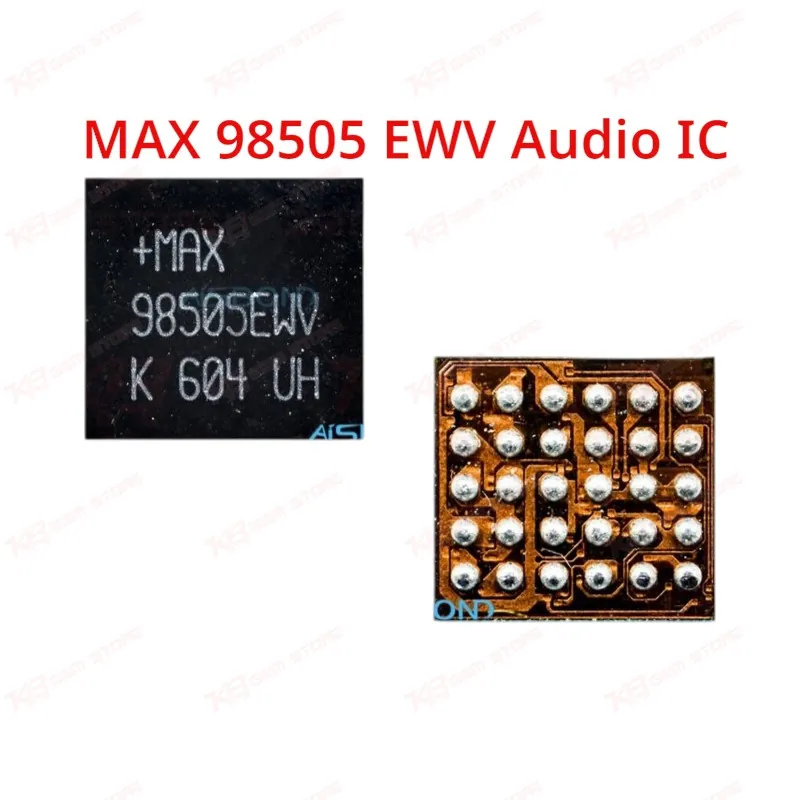
MAX 98505 EWV Audio IC
MAX 98505 EWV Audio IC
Regular price
Rs.200.00 PKR
Regular price
Sale price
Rs.200.00 PKR
Shipping calculated at checkout.
Quantity
Couldn't load pickup availability
The MAX98505EWV is a Class DG mono audio power amplifier IC from Maxim Integrated, built around an integrated 2.3MHz boost converter that keeps the external inductor as small as 1μH. It drives up to 6.5W into a 4Ω load and works as the dedicated speaker amplifier on Samsung Galaxy S6, Galaxy S6 Edge, and Galaxy Note4 mainboards. Technicians reach for this chip when a phone comes in with no sound, a weak speaker, or a dead audio output after a drop or liquid damage. Reflow-friendly WLP construction keeps it compatible with standard hot air rework benches.
⚖️ Weight: 0.01 kg
SKU:MST-IC-102
- Safe & Secure Payment
- Fast Delivery
- WhatsApp Support


Description
FAQ
What is the product name?
The product name is MAX98505EWV Class DG Mono Audio Amplifier IC.
What is the brand of this product?
The brand of this product is Maxim Integrated (Analog Devices).
What is the model of this product?
The model of this product is MAX98505EWV.
What is this product used for?
This product is used as the speaker amplifier IC that drives audio output on the mainboard.
Which devices are compatible with this product?
This product is compatible with Samsung Galaxy S6, Galaxy S6 Edge, and Galaxy Note4 mainboards.
Who should use this product?
This product is suitable for mobile repair technicians, repair shops, service centers, and professional GSM technicians.
Does the MAX98505EWV need an external inductor to function?
Yes, it needs a small 1μH external inductor for the integrated boost converter, or it can bypass the boost stage and run from an external supply directly.
What speaker fault symptoms point to a bad MAX98505EWV?
No sound from the loudspeaker, distorted or crackling output, or intermittent audio that changes when the board flexes, especially on boards with prior liquid exposure.