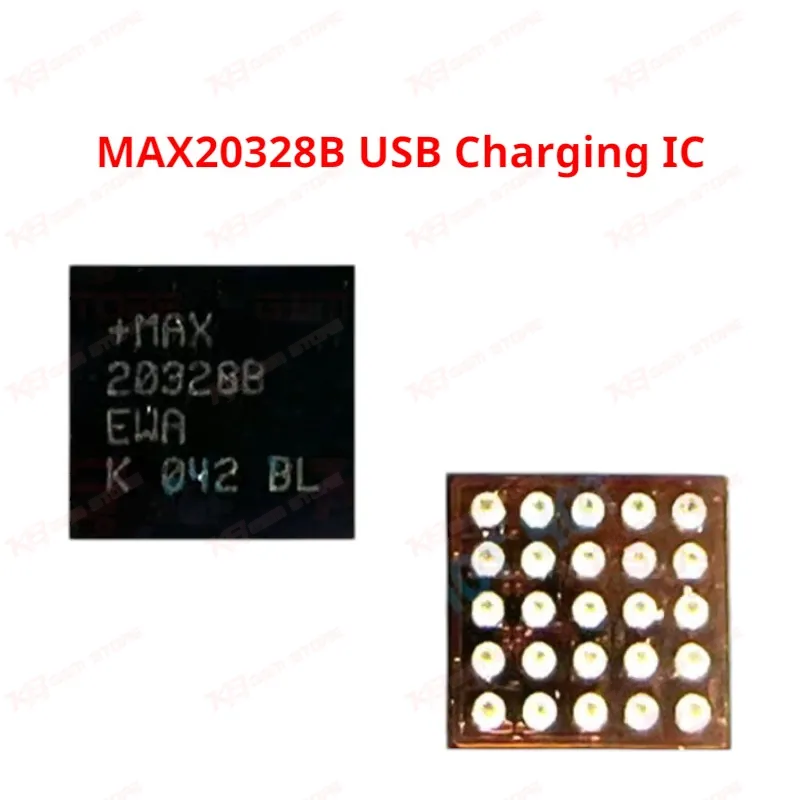
Board technicians dealing with a dead USB-C port, missing audio-on-USB-C function, or a board that survived a bad power delivery surge will run into the MAX20328B sooner or later. This IC sits directly in the Type-C signal path on many phones and tablets, and it does two jobs at once: it switches the DP/DM and SBU lines between USB data mode and analog audio mode, and it protects those same lines from overvoltage events coming through the USB-C connector. On a normal USB-C port, the data and SBU lines carry low-voltage signals. Once USB Power Delivery negotiates a high-voltage charging profile on the same connector, a short or a cable fault can push that high voltage onto lines that were never designed for it — and that's exactly the failure the MAX20328B guards against. It carries two independent OVLO (overvoltage lockout) blocks with a threshold you can program to 3.37V, 4.00V, 4.70V, or 5.00V, plus ±25V surge tolerance directly on the USB-C-facing pins and ±12kV HBM ESD protection. When a technician sees a board with a burnt or blown Type-C IC after a bad cable or a fake fast-charger event, this is one of the parts that typically takes the hit first. The audio side is where the "switch" part of the name comes from. When a USB-C headphone adapter or accessory gets plugged in, the MAX20328B automatically detects microphone and ground orientation, checks headphone impedance, and routes the signal accordingly — without needing the application processor to sort out the wiring. It also disables microphone bias the instant it detects a CC-pin connection event, which is what stops that pop or click noise technicians hear when swapping accessories on a bad or counterfeit IC. On the electrical side, it supports ±5V audio signals with -100dB THD+N and -100dB PSRR at 217Hz, so the analog path stays clean even with PD-capable high-voltage charging active on the same connector. Power-wise, the chip runs off a 2.7V to 5.5V supply rail, draws around 256µA typical (400µA max) in normal operation, and drops to just 3.9µA typical in shutdown — important for boards where standby current directly affects battery drain complaints after a repair. Undervoltage lockout kicks in around 2.395V rising and 2.365V falling, keeping the switch paths disabled until the supply is stable. All of this is packed into a 5×5 array, 25-bump, 0.4mm pitch WLP measuring just 2.31mm × 2.31mm, so it's a fine-pitch reballing or hot-air job rather than a simple hand-solder swap. For repair shops, the practical value is straightforward: a phone that shows charging issue symptoms, dead USB-C data, no audio through a Type-C adapter, or a hang after a surge event on the port is a candidate for this IC once other charging-port faults are ruled out. Because the MAX20328, MAX20328A, and MAX20328B are pin-to-pin and register compatible, technicians working from schematics referencing any of the three variants can use this part as a direct swap without redesigning the surrounding circuit. Always confirm orientation and reflow profile carefully given the fine-pitch WLP package — a misaligned reball is the most common cause of a "still dead after IC change" comeback on this part.