


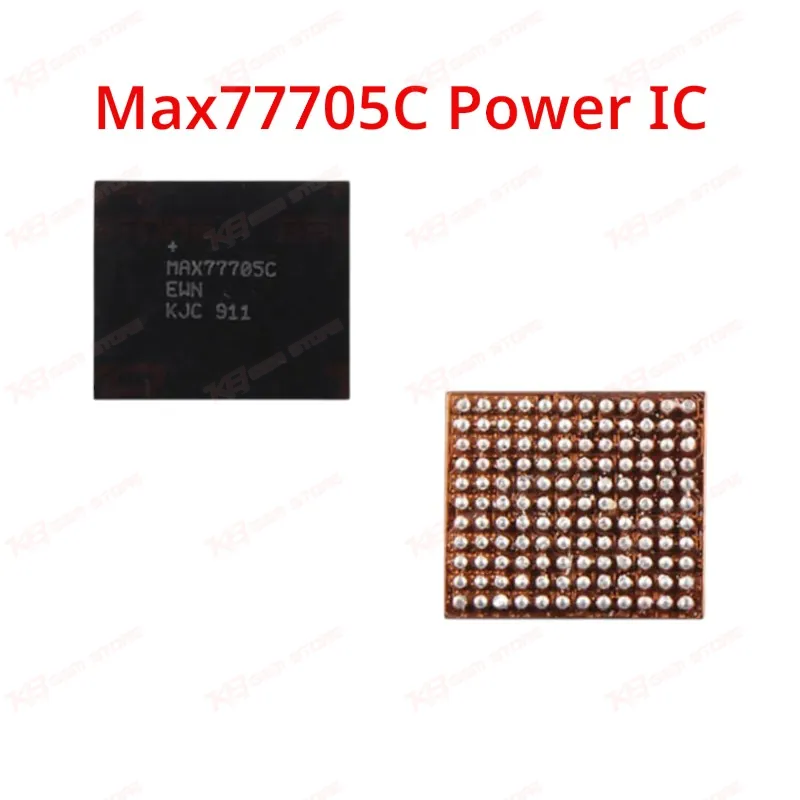
Max77705C Power IC
Max77705C Power IC
Regular price
Rs.250.00 PKR
Regular price
Sale price
Rs.250.00 PKR
Shipping calculated at checkout.
Quantity
Couldn't load pickup availability
The MAX77705C is a Maxim Integrated power management IC built for Samsung Galaxy motherboards, handling charging control, fuel gauge readings, Type-C detection, and MUIC switching in one BGA chip. Technicians reach for this IC when a phone shows dead-after-charge symptoms, stuck battery percentage, fast charging failure, or Type-C port not detecting. It also drives the haptic motor and notification LED on supported boards. Use it for board-level reballing and IC replacement work on Samsung repair jobs, from S-series to Note and foldable boards. A core PMIC for any GSM repair bench working on Samsung hardware faults.
⚖️ Weight: 0.01 kg
SKU:MST-IC-230
- Safe & Secure Payment
- Fast Delivery
- WhatsApp Support


Description
FAQ
What is the product name?
The product name is MAX77705C Power Management IC.
What is the brand of this product?
The brand of this product is Maxim Integrated (Analog Devices).
What is the model of this product?
The model of this product is MAX77705C.
What is this product used for?
This product is used for battery charging control, fuel gauge readings, Type-C detection, and haptic/LED driving on Samsung Galaxy motherboards.
Which devices are compatible with this product?
This product is compatible with Samsung Galaxy S8 through S23 FE, Note 9/10/20 series, Z Fold/Flip series, and Galaxy Tab S7 series boards.
Who should use this product?
This product is suitable for mobile repair technicians, motherboard reballing specialists, repair shops, and service centers handling Samsung hardware faults.
Can a faulty MAX77705C cause a phone to show dead-after-charge or boot loop symptoms?
Yes, a degraded MAX77705C can cause charging failure, erratic battery percentage, or power instability that presents as dead-after-charge or boot loop behavior on affected boards.
Does replacing MAX77705C require BGA reballing equipment?
Yes, since it's a BGA motherboard component, replacement needs hot-air reflow and reballing tools rather than standard soldering.