


Brand:
MECHANIC
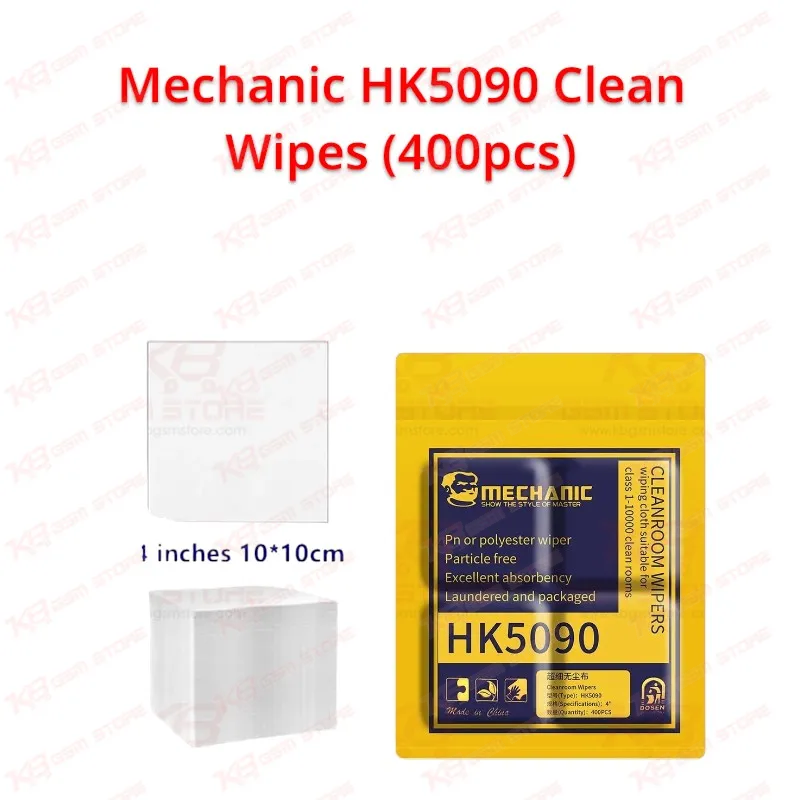
Mechanic HK5090 Clean Wipes (400pcs)
Mechanic HK5090 Clean Wipes (400pcs)
Regular price
Rs.1,000.00 PKR
Regular price
Sale price
Rs.1,000.00 PKR
Shipping calculated at checkout.
Quantity
Couldn't load pickup availability
The Mechanic HK5090 Clean Wipes (400pcs) give your repair bench a steady supply of 10 x 10 cm anti-static, dust-free microfiber wipers made from 100% polyester. Use them dry or with isopropyl alcohol to clean LCD and OLED panels before OCA lamination, lift flux residue after IC work, and prep camera lenses, back glass, and connectors without leaving lint behind. The soft, absorbent cloth dries surfaces without water marks and resists pilling during hard scrubbing. With 400 wipes in one sealed pack, mobile repair shops and service centers across Pakistan get a cost-effective daily consumable for every workstation.
SKU:MST-SOLDERING-ACCESSORIES-910
⚖️ Weight: 0.5 kg
- Safe & Secure Payment
- Fast Delivery
- WhatsApp Support


Description
FAQ
What is the product name?
The product name is Mechanic HK5090 Clean Wipes (400pcs).
What is the brand of this product?
The brand of this product is MECHANIC.
What is the model of this product?
The model of this product is HK5090.
What is this product used for?
This product is used for lint-free, anti-static cleaning of phone screens, LCD/OLED panels, camera lenses, PCBs, and other sensitive electronic surfaces during mobile repair work.
Which devices are compatible with this product?
This product is compatible with mobile phones, tablets, cameras, laptops, eyeglasses, and circuit boards, as it is a universal cleaning wiper and not device-specific.
Who should use this product?
This product is suitable for mobile repair technicians, repair shops, service centers, and professional users.
Can I use the Mechanic HK5090 wipes with isopropyl alcohol to clean flux from a PCB?
Yes. You can use the wipes dry or dampened with isopropyl alcohol, and the lint-free polyester microfiber lifts flux residue without leaving fibers on pads, solder balls, or small components.
Are these wipes safe for cleaning an LCD before OCA lamination?
Yes. The anti-static, non-dust microfiber cleans the panel without shedding lint and helps reduce dust attraction, which lowers the chance of dust spots and bubbles under the OCA.