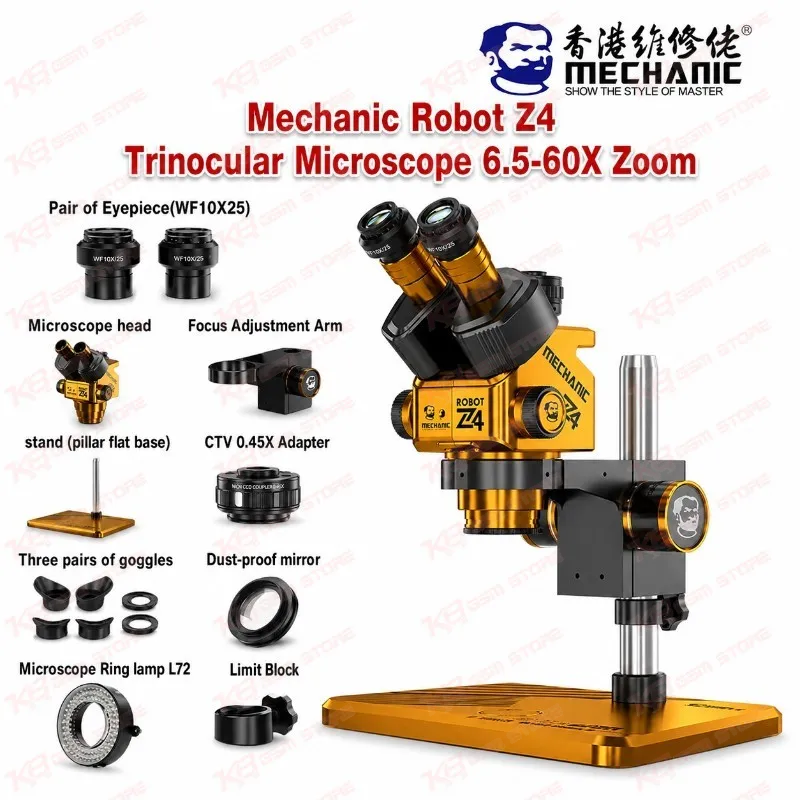
Every technician knows the moment: a dead phone lands on the bench, the multimeter shows a short on the main rail, and the culprit hides somewhere among hundreds of tiny capacitors that your eyes alone cannot separate. The Mechanic Robot Z4 Trinocular Microscope 6.5-60X Zoom gives your workshop the optical depth to finish that job properly instead of guessing, and it does so with a stereo optical path that keeps true depth perception at every magnification step. Stereo vision matters more than most new shop owners realize, because when you lift a PMIC with hot air or drop a jumper wire onto a broken trace, you need to judge height and distance between the tweezer tip and the pad, and a flat single-camera screen cannot give you that. The Robot Z4 head runs a continuous zoom from 6.5X to 60X through a prism-group design, so you start wide at 6.5X to scan the whole logic board for burnt components, water damage corrosion, or a lifted pad, then roll the zoom knob up to 40X or 60X when you need to check the solder joint under a charging IC or confirm that every ball on a reballed chip sits evenly. The WF10X/25 wide-angle eyepieces carry adjustable diopters, which lets two technicians in the same shop share one microscope without fighting over focus, and the 45-degree inclined head rotates a full 360 degrees so you can swing the view toward whichever side of the bench suits the job. Long hours at a repair counter in Lahore, Karachi, or Islamabad take a toll on the neck and back, and a comfortable viewing angle turns a twelve-hour Saturday of board work into something your body can actually handle. The trinocular port separates this model from a basic binocular unit. Mechanic supplies a CCD 0.45X camera adapter in the box, and the 0.45X reduction throws a wider field onto the camera sensor than a standard 1X mount, so an HDMI or USB microscope camera shows more of the board on your monitor. Shops that record repair videos for YouTube, Facebook, or WhatsApp customer updates get clean footage straight from the optical path, and training institutes can project live micro soldering work to a full class instead of crowding students around one eyepiece. You also get a dust-proof lens fitted at the eyepiece barrel, which matters in Pakistani workshops where dust and summer heat build up fast and a dirty prism quietly kills image clarity over a few months. The B11 aluminum alloy base deserves its own mention, because a microscope only performs as well as its stand allows. When you push a hot air nozzle close to a CPU or drag a soldering iron along a flex connector, any wobble in the stand turns 60X magnification into a shaking blur. The heavy alloy pillar base on the Robot Z4 holds the head rock-steady, and its wide footprint leaves room for a PCB holder directly underneath so the board stays locked while you work. An LED ring lamp ships with the kit and mounts around the objective to spread even, shadow-free light across the work area, which helps when you hunt for a cracked capacitor or a hairline trace break on a phone that came in with a network issue or a display problem. The package also includes a focus adjustment arm, a limit block for setting your working height, a dust-proof mirror, and two pairs of goggles, so the kit covers a full bench setup from day one. Think about where the Robot Z4 fits in your actual repair workflow. Diagnosis starts with a DC power supply and multimeter readings, and once you narrow a short to one section of the board, the microscope takes over for visual confirmation. During IC change work, you remove the old chip with hot air, clean the pads with solder wick and flux, inspect every pad at high zoom for bridges or torn copper, then reball with a stencil before placing the new chip. Every one of those steps runs faster and cleaner under proper stereo magnification. Software technicians benefit too, because ISP and eMMC/UFS direct-access jobs on dead phones depend on soldering thin wires to test points smaller than a millimeter, and a hand that cannot see the point clearly lifts it, turning a simple data recovery or FRP lock job into a hardware fault. Pair the Robot Z4 with ISP pinout tools, eMMC programmers, and UFS adapters, and your ISP work stops depending on luck. Phones stuck in a boot loop or hanging on the logo after a failed flash sometimes trace back to a cracked solder joint on the memory chip, and only close visual inspection reveals that kind of fault before you run the box again. Charging issues on Samsung, Oppo, Vivo, Infinix, Tecno, Xiaomi, and iPhone boards often come down to a damaged charging IC, a blown fuse, or a corroded connector pin, and the 6.5-60X range covers every one of those inspections without swapping lenses. The Z4 head also accepts optional auxiliary objective lenses, so you can change working distance and magnification later as your bench work grows. Shop owners comparing options usually weigh a binocular model against a trinocular one, and the decision comes down to growth. A binocular unit handles basic soldering, but the moment you want to document repairs, train a junior technician, or show a customer exactly which part failed, the camera port pays for itself. Customers trust a technician more when they see the burnt component on screen, and that trust turns directly into fair repair charges and repeat walk-ins. Moving up from a magnifier lamp or entry-level binocular microscope to the Robot Z4 also raises your first-time fix rate, since you catch bridged pins and cold joints before the phone goes back to the customer rather than after it returns with the same complaint. For a complete micro soldering bench, combine this microscope with a quality soldering station, a temperature-controlled hot air station, a sturdy PCB holder, a reballing kit, test boxes for diagnostics, and a reliable multimeter, and browse our microscopes category if you need a different magnification range or a binocular alternative. KB GSM Store stocks the genuine Mechanic Robot Z4 kit with the full accessory set, so you receive exactly the configuration described here, ready to set up on your repair bench and start working.