


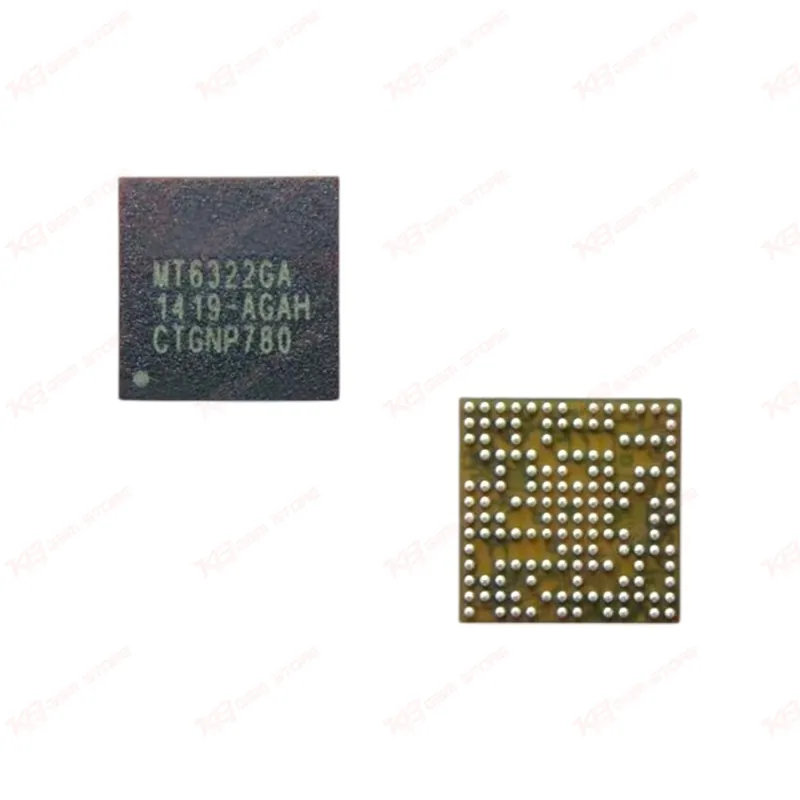
MT6322GA WiFi IC
MT6322GA WiFi IC
Regular price
Rs.250.00 PKR
Regular price
Sale price
Rs.250.00 PKR
Shipping calculated at checkout.
Quantity
Couldn't load pickup availability
The MT6322GA, commonly sold in the Pakistani repair market as the "MT6322GA WiFi IC," is actually a MediaTek power management chip (PMIC) that controls battery charging, power-on sequencing, and voltage regulation on the board. Technicians reach for this chip when a device shows dead phone symptoms, charging issue faults, or hang on logo after a failed boot sequence. It comes as a BGA component, so you'll need proper reballing and hot air skills to swap it out. Verified cross-reference models include HTC D620G, Infinix X506, and G750-U10. Order it for chip-level board repair, not as a plug-and-play accessory.
⚖️ Weight: 0.01 kg
SKU:MST-IC-43
- Safe & Secure Payment
- Fast Delivery
- WhatsApp Support


Description
FAQ
What is the product name?
The product name is MT6322GA WiFi IC.
What is the brand of this product?
The brand of this product is MediaTek (MTK).
What is the model of this product?
The model of this product is MT6322GA.
What is this product used for?
This product is used for chip-level power management repair, including dead phone diagnosis, charging issue fixes, and power rail troubleshooting on compatible boards.
Which devices are compatible with this product?
This product is verified compatible with HTC D620G, Infinix X506, and G750-U10 boards.
Who should use this product?
This product is suitable for mobile repair technicians, repair shops, service centers, and professional users.
Is the MT6322GA actually a WiFi chip or a power management chip?
It's listed in the parts market as a WiFi IC, but the verified MediaTek datasheet identifies it as a fully integrated PMIC handling power sequencing, LDO regulation, and battery charging — not a WiFi radio chip.
Does the MT6322GA support dead-battery charging on boards that won't power on?
Yes, it includes BC1.1 dead-battery charging support with timer and trickle current protection, which is why replacing it often restores charging on a completely dead board.