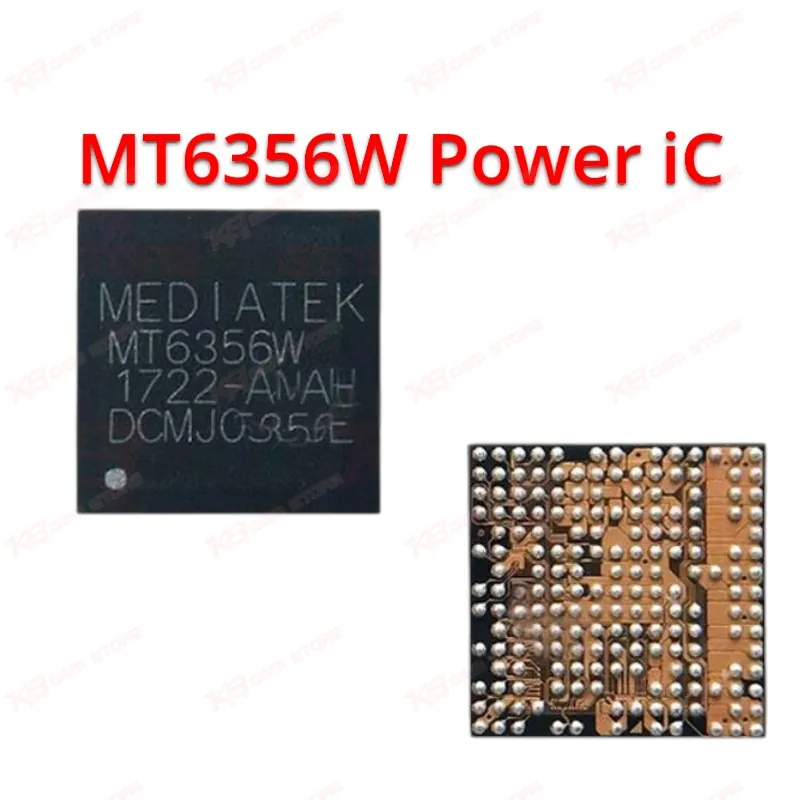
The MT6356W is a MediaTek power management integrated circuit that sits at the center of the phone's power distribution system. On any MediaTek-based board that uses this PMIC, the CPU, RAM, modem, and peripheral blocks all draw their regulated voltage from this single chip. When a phone comes in dead, stuck on logo, or drawing abnormal current, the MT6356W is one of the first components a technician checks, since a fault here directly cuts power to the application processor. This chip integrates 6 buck converters and 31 low-dropout regulators (LDOs) inside one package. The buck converters step down the main battery voltage to the lower core voltages the CPU and memory need, while the LDO bank supplies cleaner, tightly regulated power to sensitive subsystems like the camera, display, and RF front end. Running this many regulators through one IC keeps the board compact and reduces the number of discrete power components a repair technician has to trace during diagnosis. Beyond raw voltage regulation, the MT6356W also handles power sequencing, meaning it controls the order in which different rails power up and shut down during boot and shutdown. Get this sequencing wrong through a faulty IC or bad solder joint, and the board can hang on logo, boot loop, or fail to power on at all. The chip also carries an integrated RTC (real-time clock) macro, which keeps the phone's clock and certain low-power functions alive even when the main battery is disconnected, and a built-in fuel gauge function that tracks battery charge state for the software layer. An onboard audio codec block is another feature bundled into this PMIC, handling the analog side of audio input and output. On boards where the MT6356W is the power IC, audio issues (no sound, distorted output, or mic not working) can sometimes trace back to this same chip rather than a separate dedicated audio IC, which is worth knowing before a technician starts pulling other components. There's also a driver output for an ERM-type vibrator motor, so vibration function faults on affected boards can, in some cases, connect back to this IC as well. For repair work, the MT6356W is a reballing and hot air rework candidate. Common failure symptoms linked to a faulty PMIC include a completely dead phone with no charging response, a board that draws current but never boots, random restarts, charging issues where the battery doesn't charge despite a good charging port and cable, and hang-on-logo situations that survive a software flash. Since this IC handles multiple rails at once, a technician doing point-to-point testing on a dead board will typically probe the buck converter and LDO output pins on the MT6356W early in the diagnostic process, checking for missing or unstable voltages before deciding whether the fault is the PMIC itself or a downstream short. Because MediaTek PMICs across the MT635x family share a similar footprint and function layout, technicians should always confirm board schematics or match the exact part marking before swapping this IC, since using the wrong PMIC variant on a board can cause additional damage rather than fixing the original fault. Precision BGA reballing and correct reflow profile matter here, since misaligned balls or cold joints on a power IC commonly present as intermittent power issues that are harder to diagnose than a clean dead-on-arrival failure. KB GSM Store supplies genuine, tested MT6356W chips for repair shops, mobile service centers, and independent technicians across Pakistan who need a dependable power IC replacement for MediaTek-based board repair work.