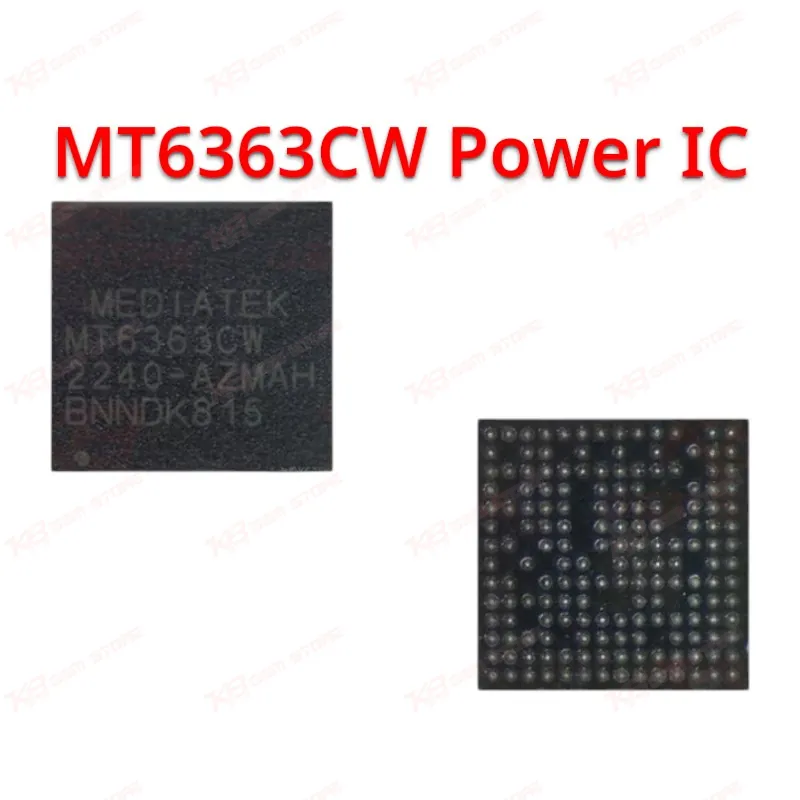
When a Dimensity 9400 board comes into your workshop completely dead or stuck in a boot loop with no obvious short, the MT6363CW is one of the first ICs worth checking. This is MediaTek's SPMI-connected power management IC, and on MT6991-based boards it carries the job of feeding voltage directly to the CPU cores — not a peripheral rail, but the core power path itself. The MT6363CW communicates with the SoC over the System Power Management Interface (SPMI) bus rather than the older I2C interface used on many previous-generation MediaTek PMICs. That distinction matters at the bench: if you're used to probing MT6357 or MT6358-era boards, the SPMI wiring and register layout on MT6363-based designs work differently, so treat it as its own family rather than assuming legacy PMIC behavior carries over. Inside the chip, two of its buck converters do the heavy lifting for CPU power. BUCK1 feeds the CPU-Little cluster with an output range of 0.4V to 1.193V and a maximum current rating of 5,000mA, while BUCK2 feeds the CPU-Big cluster across the same voltage window but at a higher 10,000mA maximum current. Both rails default to a 0.75V startup voltage and step in 6.25mV increments, giving the SoC fine-grained control over dynamic voltage scaling as the processor shifts between light and heavy workloads. Beyond these CPU rails, the MT6363CW also integrates additional buck regulators, an auxiliary ADC block for system monitoring, RTC support, GPIO control lines, eFuse storage, key and LED control functions, and its own interrupt controller — all packed into a single multi-function package rather than spread across several discrete chips. For a Pakistani repair bench, this IC shows up in a handful of recognizable fault patterns. A board that won't power on at all, one that hangs on logo after a software marna attempt, or one that draws current but never boots past the CPU init stage are all reasons to put the MT6363CW on your suspect list. Because it directly powers the CPU-Little and CPU-Big cores, a faulty or shorted MT6363CW can present as a dead-after-flash symptom even when the flash tool reports no communication error — the board simply never gets stable core voltage to complete boot. Before jumping to IC change, always confirm there's no external short pulling the rail down and check continuity on the SPMI lines between the SoC and the PMIC. Reballing this chip demands the same discipline as any modern fine-pitch PMIC: proper preheating, a clean stencil match, and controlled reflow temperature to avoid damaging neighboring components on a densely packed flagship board. Since the MT6363CW sits in the direct CPU power path, incorrect reflow or a cold joint here won't just cause instability — it can prevent the board from booting entirely or cause it to reset under load once temperatures rise. This IC is stocked by KB GSM Store as a genuine component for board-level technicians who need a reliable source for Dimensity 9400 and MT8196-platform power management repairs, without guessing on compatibility or settling for mislabeled substitutes.