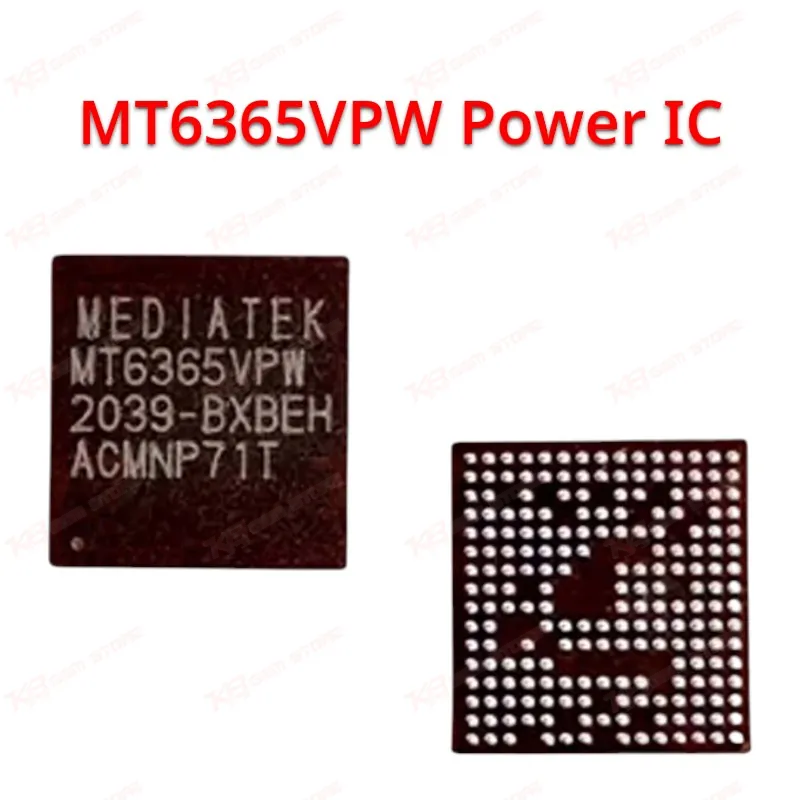
Board-level technicians run into the MT6365VPW constantly, and once you know the fault pattern, the chip earns its reputation fast. It's a MediaTek power management IC designed to sit at the center of a phone's power tree, feeding regulated voltage to the CPU, RF sections, display driver, and various sub-modules on the board. When a customer brings in a dead phone that won't power on, shows no charging current draw, or hangs on logo after a repair attempt elsewhere, the MT6365VPW is one of the first chips worth checking with a thermal camera or short test.Inside the package, MediaTek built this PMIC around a bank of buck converters paired with a large set of LDO regulators, all managed through an SPI control interface. That combination lets one chip handle power sequencing for dozens of voltage rails instead of relying on discrete regulators scattered across the PCB. The SRCLKEN control pins coordinate clock buffering to baseband and connectivity sections, and the built-in RTC alarm control keeps the real-time clock circuit alive independently. For a technician, this design means a single IC failure can knock out charging, boot sequencing, and several peripheral rails simultaneously — which is exactly why boards that "won't take charge" or "die randomly" so often point back to this component.Input voltage on the MT6365VPW/B variant runs from 3.0V to 5.5V, matching typical lithium battery and USB charging input ranges you'll see on the bench. Output voltage regulation spans 0.8V to 4.5V, wide enough to cover low-voltage core rails as well as higher-voltage peripheral supplies on the same board. Built-in protection circuitry — overvoltage protection, overcurrent protection, short-circuit protection, and thermal shutdown — is what actually saves boards during liquid damage or reverse-polarity charging accidents, since the chip cuts power delivery before a cascading short can spread to surrounding components.On the repair bench, this IC shows up across a wide compatibility range. Xiaomi and Redmi boards use it heavily — Poco M3 Pro, Poco M4, Poco 6 Neo, Redmi 10, Redmi Note 10 5G, Note 10T, Note 11 Pro, Note 11S, Note 12 Pro, and Note 13 all carry it. On the Oppo and Realme side, you'll find it on A53s, A56, A78, Reno 7, Reno 10, Reno 11, Reno 11F, Realme 8, Realme 9 Pro, and Realme 10 Pro boards. Vivo boards including Y36, Y72, Y75 5G, Y76, V23, and V25 also run this PMIC, along with Samsung A34 and A14, Tecno Pova 5G, and Infinix Hot 20, Zero 5G, and X6815 series boards. That's a lot of overlap across brands, which makes the MT6365VPW a chip worth stocking rather than sourcing per job.Reballing this IC follows standard BGA rework practice — controlled preheat, correct hot air nozzle sizing for the package footprint, flux application before and after ball placement, and a reflow profile that avoids overheating neighboring components. Since this PMIC touches so many rails at once, always check for shorts on the main power line before reinstalling, and confirm current draw on the bench power supply matches expected values for a healthy board before handing the phone back. Skipping that verification step is how "IC change karna" turns into a repeat visit when an underlying short elsewhere on the board was actually the root cause.For shops handling volume repair work across Xiaomi, Oppo, Vivo, and Realme lineups, keeping genuine MT6365VPW stock on hand cuts turnaround time significantly compared to waiting on a per-order basis, especially for dead-on-arrival and no-charging cases that are common walk-in complaints.