


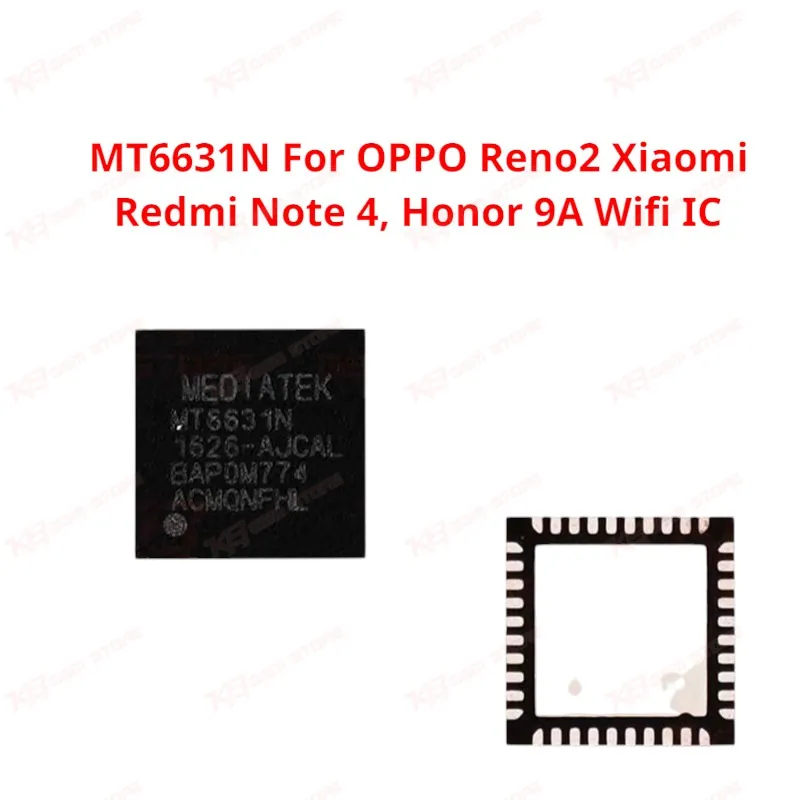
MT6631N For OPPO Reno2 Xiaomi Redmi Note 4, Honor 9A Wifi IC
MT6631N For OPPO Reno2 Xiaomi Redmi Note 4, Honor 9A Wifi IC
Regular price
Rs.250.00 PKR
Regular price
Sale price
Rs.250.00 PKR
Shipping calculated at checkout.
Quantity
Couldn't load pickup availability
The MT6631N is a MediaTek WiFi/Bluetooth combo IC used in OPPO Reno2, Xiaomi Redmi Note 4, and Honor 9A boards. This chip handles wireless connectivity functions and is a common replacement part when a phone shows no WiFi networks, weak signal, or Bluetooth failure despite normal software behavior. Genuine MediaTek chip, suitable for reballing and direct board-level replacement by trained GSM technicians. Test your board properly before ordering to confirm the fault lies with the WiFi IC and not the antenna or software.
⚖️ Weight: 0.01 kg
SKU:MST-IC-115
- Safe & Secure Payment
- Fast Delivery
- WhatsApp Support


Description
FAQ
What is the product name?
The product name is MT6631N WiFi IC.
What is the brand of this product?
The brand of this product is MediaTek.
What is the model of this product?
The model of this product is MT6631N.
What is this product used for?
This product is used to repair WiFi and Bluetooth failures on phone boards through IC reballing or replacement.
Which devices are compatible with this product?
This product is compatible with OPPO Reno2, Xiaomi Redmi Note 4, and Honor 9A boards.
Who should use this product?
This product is suitable for mobile repair technicians, repair shops, service centers, and professional users.
Does the MT6631N need a separate crystal oscillator to function?
No, the MT6631N does not have its own dedicated oscillator; it uses an external clock source or a clock signal from the platform's companion chip, so a faulty clock source elsewhere on the board can still cause WiFi failure even after replacing this IC.
Can the MT6631N cause GPS or FM problems along with WiFi failure?
Yes, since the MT6631N is a 4-in-1 chip integrating WiFi, Bluetooth, GPS, and FM front ends on one die, a damaged chip can produce combined symptoms across these functions rather than just WiFi alone.