


MU003 Power Charging IC
MU003 Power Charging IC
Regular price
Rs.450.00 PKR
Regular price
Sale price
Rs.450.00 PKR
Shipping calculated at checkout.
Quantity
Couldn't load pickup availability
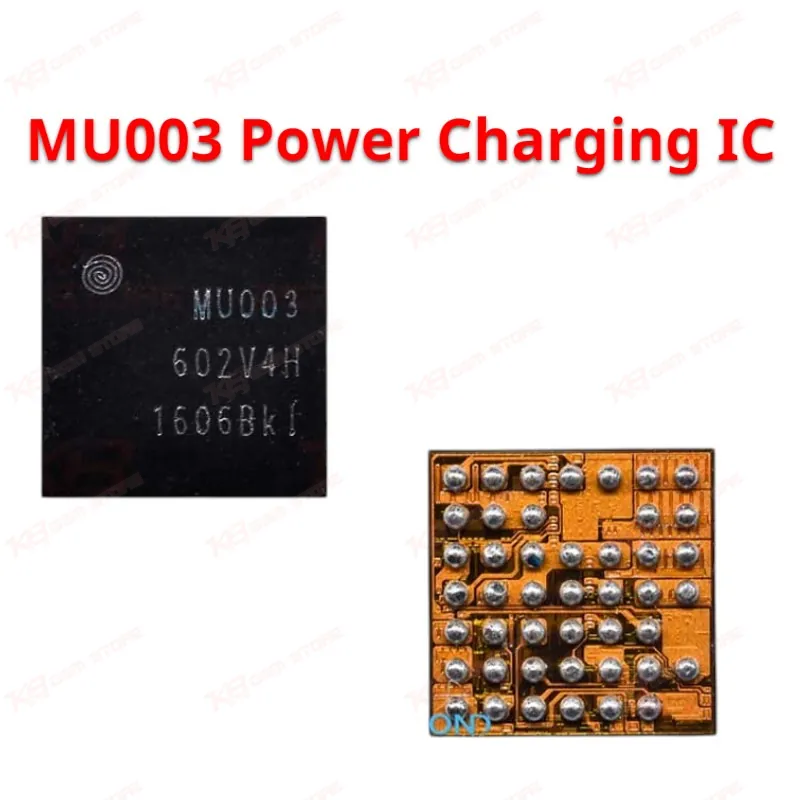
The MU003 Power Charging IC controls the main power management circuit on Samsung Galaxy A3, A5, A7, and C5 boards. This BGA-packaged PMIC handles charging regulation, power distribution, and voltage control for the motherboard. Technicians reach for this IC when a board shows no charging response, drains fast on standby, or stays dead after a software flash. The chip comes pre-balled, so you skip the reballing step and go straight to reflow. A reliable pick for your repair bench when the fault traces back to the power management stage instead of the charging port or battery connector.
⚖️ Weight: 0.01 kg
SKU:MST-IC-143
- Safe & Secure Payment
- Fast Delivery
- WhatsApp Support


Description
FAQ
What is the product name?
The product name is MU003 Power Charging IC.
What is the model of this product?
The model of this product is MU003.
What is this product used for?
This product is used for restoring the power management and charging regulation circuit on compatible Samsung board.
Which devices are compatible with this product?
This product is compatible with Samsung Galaxy A3, Galaxy A5, Galaxy A7, and Galaxy C5.
Who should use this product?
This product is suitable for mobile repair technicians, repair shops, service centers, and professional users working on Samsung board-level repairs.
Does the MU003 come pre-balled for reflow?
Yes, the MU003 ships pre-balled, so you can reflow it directly without a separate reballing station or stencil.
Can this IC fix a dead-after-flash phone that shows no charging response?
It can if the fault is hardware-level power regulation failure; if the board still draws normal current on a bench supply, reflash the firmware first before replacing the IC.