


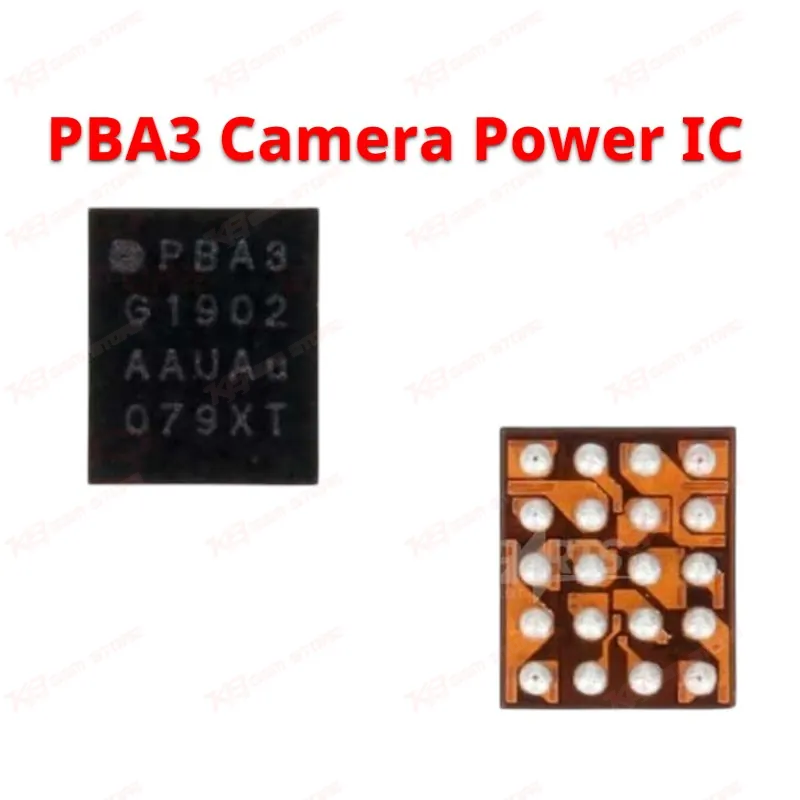
PBA3 Camera Power IC
PBA3 Camera Power IC
Regular price
Rs.500.00 PKR
Regular price
Sale price
Rs.500.00 PKR
Shipping calculated at checkout.
Quantity
Couldn't load pickup availability
The PBA3 camera power supply IC handles power regulation for the camera module on Samsung Galaxy S20, S20+, and S20 Ultra boards. When a technician sees camera black screen, camera restart loop, or camera not detected after a drop or liquid damage, this IC is one of the first checkpoints on the power rail. It ships as a single BGA chip, ready for reballing and hot air rework on your bench. Stock this IC alongside your other S20-series power ICs to keep common camera faults moving fast through your repair workflow.
⚖️ Weight: 0.01 kg
SKU:MST-IC-162
- Safe & Secure Payment
- Fast Delivery
- WhatsApp Support


Description
FAQ
What is the product name?
The product name is PBA3 Camera Power Supply IC.
What is the brand of this product?
This IC is designed for Samsung Galaxy S20-series motherboards.
What is the model of this product?
The model is PBA3.
What is this product used for?
This IC regulates power delivery to the camera module and is used to fix camera black screen, camera restart, and camera-not-detected faults.
Which devices are compatible with this product?
This IC is compatible with the Samsung Galaxy S20, Galaxy S20+, and Galaxy S20 Ultra.
Who should use this product?
This product is suitable for mobile repair technicians, repair shops, service centers, and professional users.
Can this IC fix a black screen camera issue on a Galaxy S20?
Yes, a faulty PBA3 is a common cause of black or green camera screen faults on the S20 series, and replacing it resolves the issue when the flex cable and connector test fine.
Does this IC need a stencil for reballing?
Reballing gives the cleanest result and needs a stencil matched to the PBA3's BGA footprint, though direct reflow with solder paste is possible for technicians experienced with fine-pitch BGA work.