Skip to product information
1 of 4

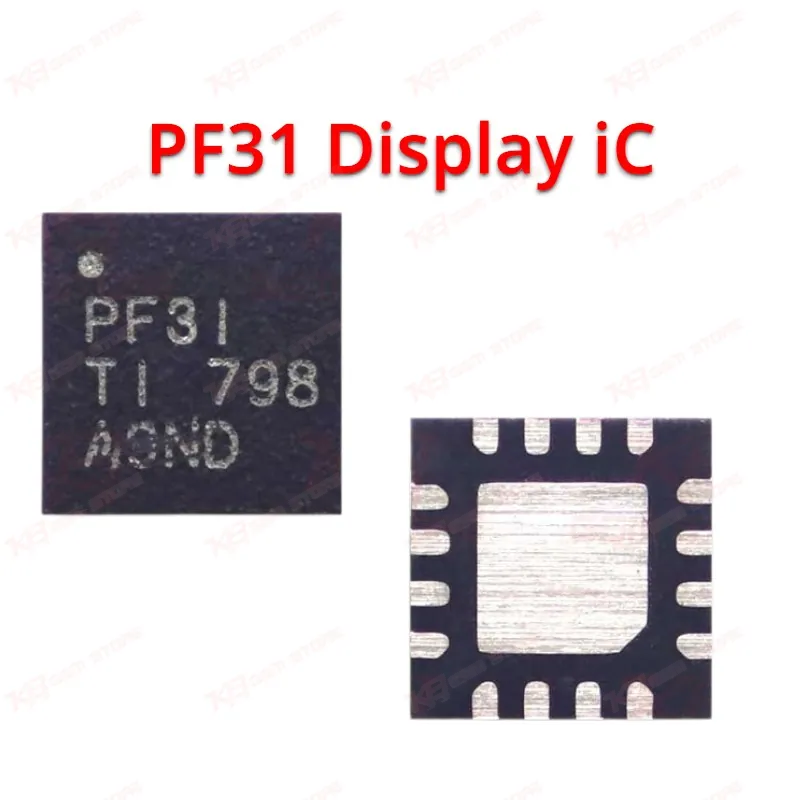
PF31 Display iC

PF31 Display iC

Regular price Rs.250.00 PKR
Regular price Sale price Rs.250.00 PKR
Sale Sold out
Shipping calculated at checkout.
Quantity

The PF31 Display iC is a 16-pin backlight driver chip that regulates the voltage and current feeding the LED backlight circuit on multiple Android LCD boards. Technicians reach for this IC when a phone powers on, the logo shows briefly or the display stays completely dark while the touch panel still responds — a classic backlight failure sign. You'll find PF31 fitted on Samsung, Meizu, Oppo, Vivo, and Xiaomi boards that share the same backlight driver layout. It replaces damaged or shorted backlight ICs after liquid damage, drop damage, or board-level shorts on the backlight rail. Keep a few on your repair bench for quick dark-screen diagnostics — no display disassembly required, just direct board-level swap after confirming the fault with your multimeter.

⚖️ Weight: 0.01 kg

SKU:MST-IC-334

  • Safe & Secure Payment
  • Fast Delivery
  • WhatsApp Support
View full details

Description

Dark screen with a working touch response is one of the most common complaints you'll see on your repair bench, and the PF31 Display iC sits right at the center of that fault pattern. This 16-pin backlight driver chip takes the board's supply voltage and converts it into the regulated current the display's LED backlight strip actually needs. When that regulation fails — from a short on the backlight rail, ESD damage, or corrosion after liquid exposure — the panel goes black even though the phone boots normally underneath. You'll recognize the PF31 across several device families rather than a single brand, since manufacturers reuse the same backlight driver footprint on multiple board designs. It shows up on the Samsung Galaxy Note 4 (N910F) and Galaxy On8 (G9008V), Meizu MX5 and MX6, the Oppo R9M, R9S Plus, and R7M, the Vivo X5, X9, and X20, and the Xiaomi Mi8. Before you commit to a swap, always cross-check the exact board revision against a schematic or boardview, because backlight driver placement can shift between hardware revisions of the same model. Diagnosing a backlight fault correctly saves you from an unnecessary IC change. Start with your multimeter in diode mode on the backlight rail — a dead short usually points straight at the IC or a nearby filter capacitor. Shine a flashlight at an angle across the screen while it's powered; if you see a faint image, the backlight circuit is at fault rather than the display panel or LCD connector. This distinction matters because a technician who skips this step often ends up ordering a full screen assembly for what turns out to be a ₨200 IC. Once you've confirmed the fault sits on the backlight driver itself, removal follows standard hot air rework practice. Set your hot air station to a mid-range temperature, apply flux generously around the IC, and lift it evenly to avoid pulling adjacent pads. Clean the footprint with isopropyl alcohol and inspect under a microscope for lifted pads or bridged traces before reballing and placing the new PF31. Reflow with even heat distribution, then test backlight function before you reassemble the display stack — catching a bad joint here is far easier than after the phone is back together. This IC pairs naturally with your existing ISP and board-repair workflow. If a board comes in after liquid damage, check the backlight rail alongside your usual charging and power rail inspection — corrosion rarely stays isolated to one circuit. Keep your fine-tip soldering iron, hot air station, and a good microscope on hand, since 16-pin QFN-style parts at this scale need steady hands and proper magnification to place cleanly. Stock a few PF31 units if you regularly service Oppo R-series, Vivo X-series, or the affected Samsung and Xiaomi models — dark-screen complaints on these boards come in often enough that having the part on your bench beats waiting on a supplier mid-repair. Pull the board, confirm the short, swap the IC, and you've turned what looked like a screen replacement job into a low-cost, high-margin board repair.

Key Features

  • Direct board-level replacement for backlight driver faults
  • Compatible with multiple Samsung, Meizu, Oppo, Vivo, and Xiaomi boards
  • Resolves dark-screen-with-working-touch complaints
  • Regulates voltage and current to LED backlight strip
  • Common fix after liquid damage or ESD-related backlight failure
  • Fits standard hot air rework and reballing workflow
  • Compact 16-pin footprint saves board space during repair
  • Cost-effective alternative to full display replacement

Specifications

Brand Entity Generic/Aftermarket Repair IC
Product Entity PF31 Display Backlight IC
Technology Entity LED Backlight Driver Circuit
Compatible Device Entities Samsung N910F, Samsung G9008V, Meizu MX5, Meizu MX6, Oppo R9M, Oppo R9S Plus, Oppo R7M, Oppo R11, Vivo X5, Vivo X9, Vivo X20, Xiaomi Mi8
Repair Process Entity Backlight IC Replacement, Board-Level Rework
Industry Entity Mobile Phone Repair, PCB Repair

Compatible Devices


Samsung Galaxy Note 4 (N910F), Samsung Galaxy On8 (G9008V), Meizu MX5, Meizu MX6, Oppo R9M, Oppo R9S Plus, Oppo R7M, Oppo R11, Vivo X5, Vivo X9, Vivo X20, Xiaomi Mi8 — verified at board/model level; confirm exact board revision against schematic before replacement.

Common Repair Uses


Backlight failure repair, dark/black screen with working touch, no backlight after liquid or drop damage, backlight rail short-circuit repair, board-level display troubleshooting.

FAQ

What is the product name?
The product name is PF31 Display Backlight IC.
What is the brand of this product?
This is a generic/aftermarket backlight driver IC without a fixed OEM brand.
What is the model of this product?
The model is PF31, 16-pin package.
What is this product used for?
This IC regulates voltage and current to the LCD backlight, fixing dark-screen faults where touch still works.
Which devices are compatible with this product?
It fits Samsung N910F and G9008V, Meizu MX5 and MX6, Oppo R9M, R9S Plus, R7M, and R11, Vivo X5, X9, and X20, and Xiaomi Mi8 boards.
Who should use this product?
This product is suitable for mobile repair technicians, repair shops, service centers, and professional users.
Does the PF31 IC control backlight brightness or the backlight power supply?
It regulates the voltage and current feeding the backlight LEDs rather than controlling brightness levels through software.
Can the PF31 IC be swapped across different phone brands using the same footprint?
Yes, since several OEM boards share the same 16-pin backlight driver layout, but always confirm the exact board revision against a schematic before replacement.

Ask any Query