


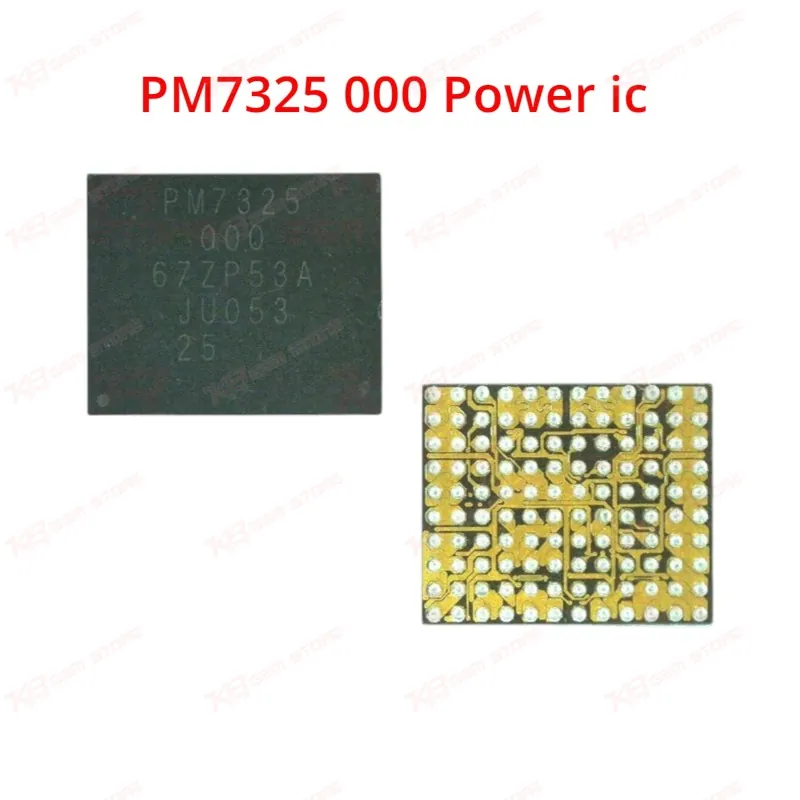
PM7325 000 Power ic
PM7325 000 Power ic
Regular price
Rs.600.00 PKR
Regular price
Sale price
Rs.600.00 PKR
Shipping calculated at checkout.
Quantity
Couldn't load pickup availability
The PM7325-000 is a genuine Qualcomm interface PMIC built for Snapdragon-based handset boards. It handles Li-ion battery charging, USB Type-C power delivery, Quick Charge negotiation, and LCD display power on the board. When a phone comes in dead, stuck on charging, or with a backlight power fault, this IC is often the root cause. You get an original component ready for reballing and board-level replacement — no guesswork on pinout or charging behavior, since it follows Qualcomm's documented PM7325 architecture used across multiple Snapdragon platforms
⚖️ Weight: 0.01 kg
SKU:MST-IC-199
- Safe & Secure Payment
- Fast Delivery
- WhatsApp Support


Description
FAQ
What is the product name?
The product name is PM7325-000 Power IC.
What is the brand of this product?
The brand of this product is Qualcomm.
What is the model of this product?
The model of this product is PM7325-000.
What is this product used for?
This product is used for battery charging control, USB power delivery, and LCD backlight power management on Snapdragon-based boards.
Which devices are compatible with this product?
This product is compatible with Snapdragon platform boards used in devices like Samsung Galaxy A52/A73/M52, Vivo V29, Oppo Reno 10 Pro, Realme GT Master, Xiaomi POCO X5 Pro, and Huawei Nova 10.
Who should use this product?
This product is suitable for mobile repair technicians, repair shops, service centers, and professional users.
Does the PM7325-000 support Qualcomm Quick Charge?
Yes, it supports Quick Charge 2.0, 3.0, and 4.0 alongside USB Power Delivery 3.0.
Can the PM7325-000 handle dual-path charging setups?
Yes, it supports up to 10A dual-path charging when paired with an SMB1393, and 4A on a single charge path.