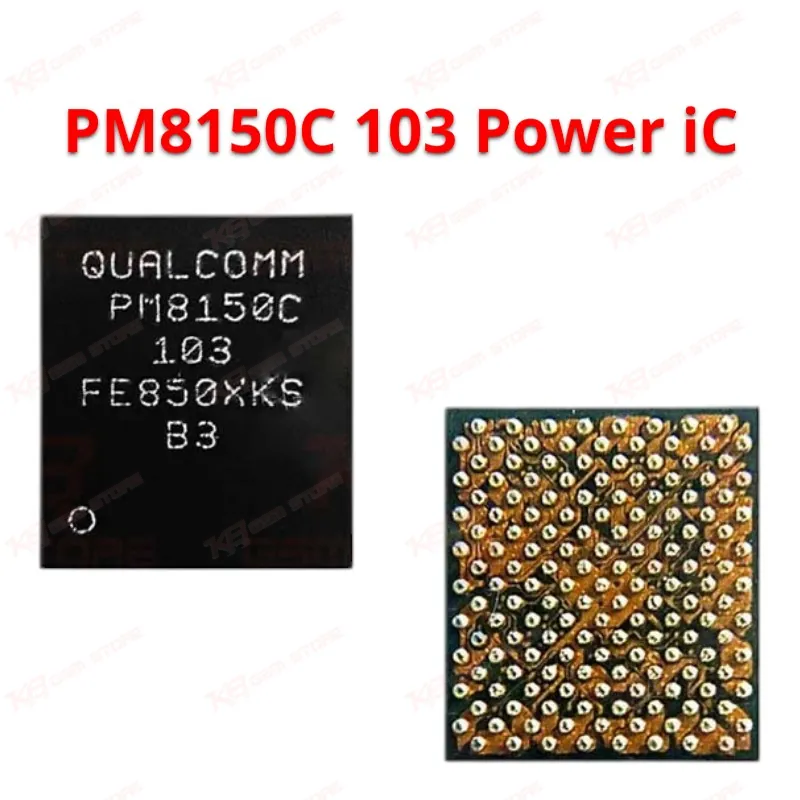
The PM8150C sits inside Qualcomm's PM8150 power management family, a set of companion PMICs designed to work together on Snapdragon 855 and Snapdragon 855+ (SM8150) platform boards. On these boards, no single chip carries the full power load. Instead, Qualcomm splits the job across PM8150, PM8150B, PM8150L, and PM8150C, each handling its own share of voltage regulation, power sequencing, and rail distribution. When any one of these ICs fails, the board loses its ability to power up correctly, and you end up with a dead phone that won't boot past logo, won't charge, or won't power on at all.For a bench technician, this makes the PM8150C a board-level component, not a plug-and-play part. You're working directly on the PCB with hot air or an IR station, removing the faulty chip, cleaning the pads, and reballing or reflowing the replacement. This is precision work — the chip sits close to other sensitive components, so you need controlled heat profiles, a steady hand, and a clean flux application to avoid collateral damage to neighboring parts.Diagnosing a PM8150C fault before you commit to a chip swap saves you time and avoids unnecessary rework. Start with a dead phone that shows zero current draw on your DC power supply, or one that draws current but never boots. Check for a short first — a shorted power rail traced back to this chip is a strong signal. If your board shows normal current draw but the device still won't power on, and you've already ruled out the main PM8150 and the PM8150B charging IC, the PM8150C becomes the next logical suspect. A hardware fault isolated to this specific power domain, rather than a charging issue or a battery problem, usually points here.This IC also comes up in liquid damage repairs. Corrosion around the power management cluster on Snapdragon 855 boards is common after water exposure, and the PM8150C sits close enough to nearby rails that oxidation or a micro-short can take it out along with adjacent components. In these cases, a full board cleanup under a microscope, followed by continuity testing on the affected rails, tells you whether the chip itself failed or whether the damage is limited to the surrounding traces.Because this is a genuine Qualcomm-sourced replacement chip, it matches the original pinout and electrical characteristics of the factory part, which matters for compatibility with existing board firmware and calibration. There's no reprogramming or software matching required for a straight power IC swap — once you've confirmed correct placement and a clean reflow, the board should power up and boot normally, assuming the fault was isolated to this chip.Keep in mind this component is not a universal power IC. It's specific to boards built around the SM8150 chipset, so confirming your device's exact processor and PMIC layout before ordering avoids a mismatch. For repair shops working regularly on Galaxy S10 and Note 10 series boards, keeping the full PM8150 family (PM8150, PM8150B, PM8150L, PM8150C) in stock together makes sense, since a power failure on these boards can trace back to any one of the four chips depending on which rail is affected.