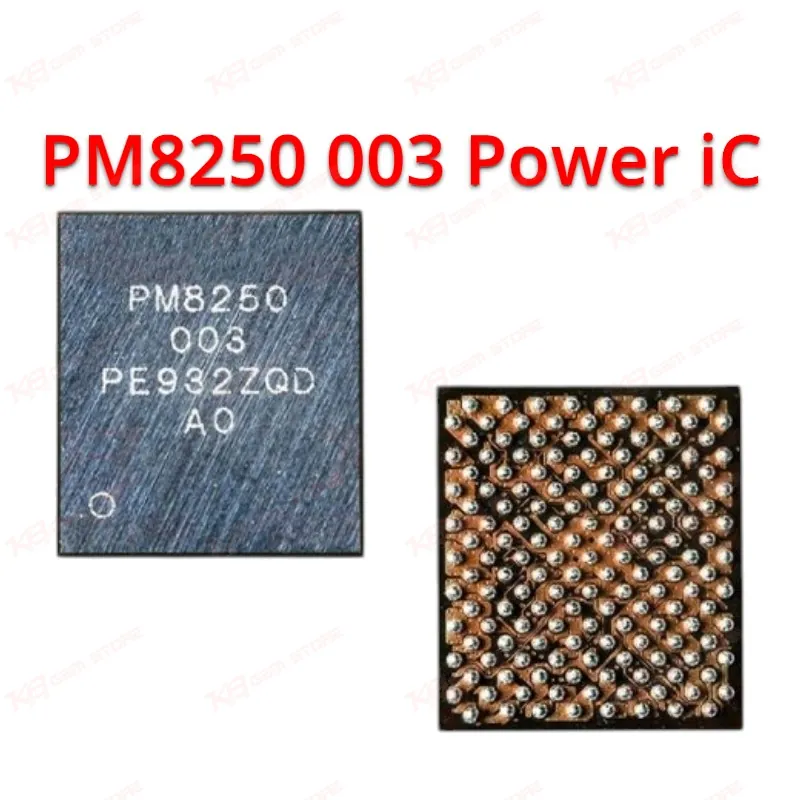
The PM8250 003 is a power management integrated circuit designed by Qualcomm specifically for the Snapdragon 865 mobile platform, known internally as SM8250. It also serves the Snapdragon 865+ and, in its PRB5165 designation, the QRB5165 chipset used in select robotics and high-performance mobile boards. On the motherboard, this IC sits at the core of the power delivery chain, converting and regulating multiple voltage rails that feed the CPU cores, GPU, RAM, modem, and camera subsystems from the main battery input. For a mobile repair technician working on a Snapdragon 865-series board, the PM8250 003 is one of the first suspects when a device shows a dead phone symptom with no display, no charging current draw, or a board that stays completely unresponsive after a flash attempt. Because this PMIC controls the initial power-up sequence, a faulty unit often prevents the processor from booting at all, even when the CPU, RAM, and other ICs test fine individually. Boards affected by moisture damage, a previous short circuit, or a failed charging repair frequently show PM8250 003 damage as the root cause once other components have been ruled out. Charging-related faults are another common reason this IC gets replaced. When a phone shows no charging, slow charging, or charging that stops intermittently, and the charging port, battery, and charging IC downstream test normal, the PM8250 003 becomes the next diagnostic step. Since it manages battery charge control and power sequencing directly, a failing unit can cause the device to draw current inconsistently or fail to recognize a connected charger altogether. Fast charging not working, despite a good cable and adapter, also points back to this chip when standard charging troubleshooting comes up empty. Power instability is the third major repair scenario. A board that boots, then shuts down randomly, restarts on its own, or hangs on logo during startup often has an unstable voltage rail somewhere in the power tree. The PM8250 003 regulates several of these rails simultaneously, so even a partial fault can create symptoms that look unrelated at first, such as camera failure, display flicker, or Wi-Fi dropping out under load. Technicians who trace these symptoms back to inconsistent voltage readings on PMIC-fed rails typically confirm the fault with a schematic and thermal imaging before committing to an IC change. Replacing the PM8250 003 requires BGA-level rework skills. The chip must be removed with a hot air station set to the correct profile for the board's other components, the pads cleaned without lifting traces, and the new IC reballed with the correct ball size and pitch before reflow. Precise temperature control matters here, since Snapdragon 865-series boards pack components densely around the PMIC and overheating adjacent parts is a real risk. A stencil matched to the PM8250 footprint, quality flux, and a microscope for alignment all improve the outcome. After reflow, the board should be power-tested before reassembly to confirm the charging and boot issues are resolved rather than masked. Sourcing a genuine, unused PM8250 003 matters because a counterfeit or previously used chip can fail again shortly after installation, costing the shop both the part and the labor. KB GSM Store supplies this IC for technicians working across Lahore, Karachi, and Islamabad who need a dependable part for Snapdragon 865 and 865+ board-level repairs, whether the job involves a straightforward IC change or a full power tree diagnosis on a flagship device.