


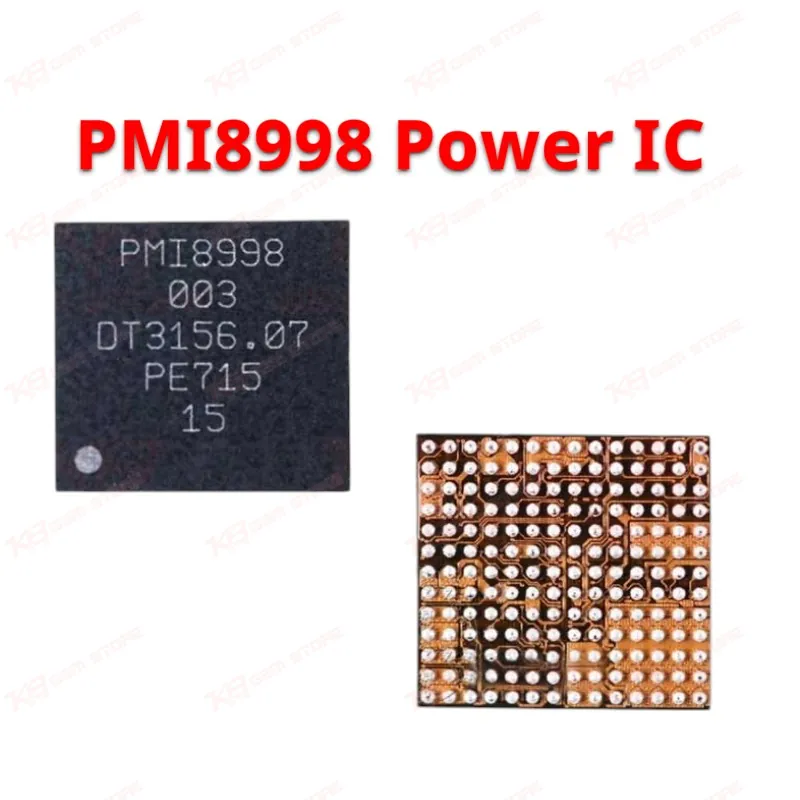
PMI8998 Power IC for Galaxy S8/S8+
PMI8998 Power IC for Galaxy S8/S8+
Regular price
Rs.250.00 PKR
Regular price
Sale price
Rs.250.00 PKR
Shipping calculated at checkout.
Quantity
Couldn't load pickup availability
The PMI8998 is the companion power management IC used in Samsung Galaxy S8 (G950) and Galaxy S8+ (G955) boards, working alongside the PM8998 main PMIC to control charging, battery management, and voltage regulation for the Snapdragon 835 platform. Technicians in Lahore, Karachi, and Islamabad reach for this chip when a Galaxy S8 or S8+ shows dead phone symptoms, no charging response, or unstable power rails after liquid damage. This is a BGA-packaged surface-mount IC that requires reflow soldering and a hot air rework station for removal and reballing. Stock this chip on your bench for fast board-level power repair jobs.
⚖️ Weight: 0.01 kg
SKU:MST-IC-165
- Safe & Secure Payment
- Fast Delivery
- WhatsApp Support


Description
FAQ
What is the product name?
The product name is PMI8998 Power Management IC for Samsung Galaxy S8 / S8+.
What is the brand of this product?
The brand of this product is Qualcomm.
What is the model of this product?
The model of this product is PMI8998.
What is this product used for?
This product is used to replace a faulty companion power management IC on Galaxy S8 / S8+ boards affected by dead phone or charging faults.
Which devices are compatible with this product?
This product is compatible with Samsung Galaxy S8 (SM-G950) and Galaxy S8+ (SM-G955).
Who should use this product?
This product is suitable for mobile repair technicians, repair shops, service centers, and professional users.
Is the PMI8998 the same as the PM8998 used on the Galaxy S8?
No, the PM8998 is the main PMIC on the board while the PMI8998 is a separate companion PMIC handling charging and secondary rails; both work together but are different chips.
Does replacing the PMI8998 fix a Galaxy S8 stuck at 0.00A on the power supply?
It can, but only after confirming the short is isolated to the PMI8998 rail on your DC power supply, since other ICs on the board can cause the same symptom.