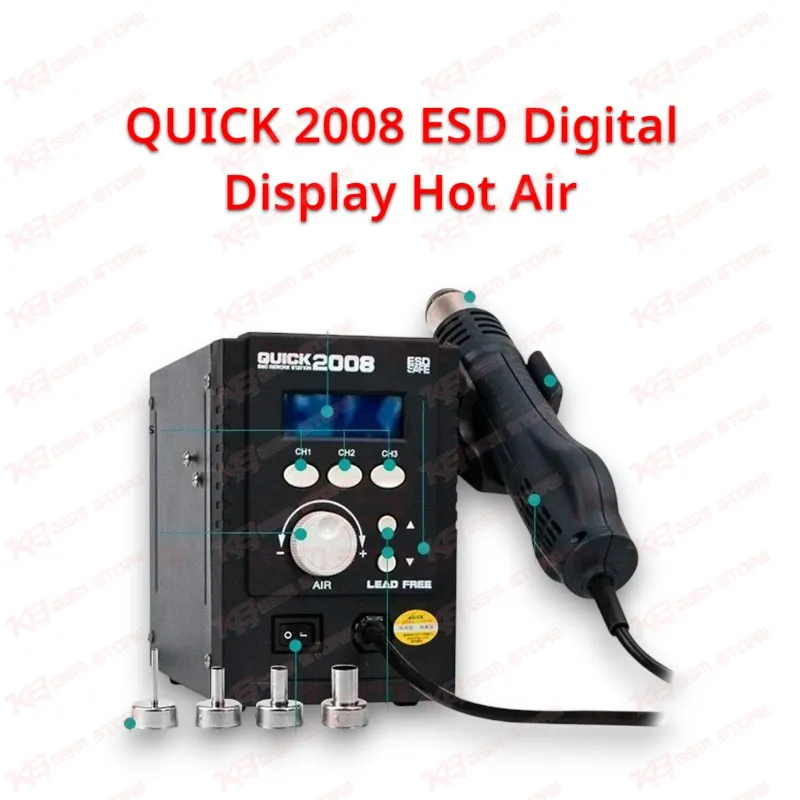
Every BGA job on your bench comes down to one thing: heat you can trust. Whether you're lifting a power IC off a dead board, reballing a CPU after a boot loop issue, or reflowing a loose display connector, the QUICK 2008 gives you a controlled, repeatable heat source instead of a guessing game. This is a workflow tool first — you're not just heating plastic, you're managing a process where 10°C of drift can crack a chip or lift a pad.The core of the QUICK 2008 is its closed-loop, zero-passage-trigger temperature control, run by an onboard microcomputer and shown on a 1°C-resolution LED digital display. Most basic heat guns let temperature swing when you change airflow — turn the fan up and the tip cools, turn it down and it spikes. The QUICK 2008 doesn't do that. Its sensor and control loop hold your set temperature steady from 100°C to 500°C regardless of how much air you're pushing, which means the same setting behaves the same way every time you pick the handle up. For lead-free desoldering, where you genuinely need higher, stable heat to break the joint without cooking the board, that consistency matters more than raw wattage.Airflow is handled separately from temperature, and that's deliberate. The brushless fan gives you a soft, adjustable wind up to 120 L/min, so you can dial in a gentle stream for reflowing a flex connector or open it up for pulling a shielded IC. Because the fan is brushless, it runs quiet — rated under 45dB — and lasts far longer than the brushed motors you'll find in budget stations, so you're not rebuilding the fan assembly every few months on a busy bench.The handle itself is built around an induction switch rather than a manual power button. Lift the handle out of its stand and the station wakes into working mode within seconds; set it back down and the system drops into standby on its own. On a bench where you're switching between soldering iron, microscope, and hot air gun all day, that one detail saves real time and stops you from leaving a hot gun running unattended between jobs. When you do finish a session, the built-in auto air-cooling function keeps air moving through the heating element after you shut down, so the element cools evenly instead of degrading from thermal shock — a big part of why these heating cores hold up over years of daily use instead of burning out in months.In terms of build, the QUICK 2008 runs on 700W at 220V, with a compact body measuring roughly 13.8cm high, 10cm wide, and 15cm long, and a 120cm handle cord that gives you enough reach to work comfortably without dragging the whole unit across the bench. At around 3.55kg, it sits solidly on a workbench without tipping when you're maneuvering the handle over a board, and the footprint stays small enough to fit next to a soldering iron stand and a microscope without crowding your work area.On a real repair bench, this station covers a wide range of jobs: removing and reballing BGA chips on motherboards, reworking connectors and shields, desoldering charging ports and camera modules, reflowing lifted pads after a rough repair, and general PCB-level rework where a soldering iron alone won't cut it. Technicians dealing with a dead phone after a failed flash, a board stuck on logo, or a hardware fault traced to a specific IC will find the temperature stability especially useful — you get one shot at removing an IC cleanly, and inconsistent heat is usually what turns that into two or three attempts, or a damaged pad. The same stability helps when you're reflowing a display connector on a phone with a display problem, or reseating a shield after tracing a charging issue back to the PMIC.Day to day, this is the kind of tool where the workflow matters as much as the spec sheet. You set your target temperature on the LED display, dial in an airflow level suited to the job — a soft, narrow stream for a small connector, a wider setting for lifting a large PMIC or CPU — and lift the handle to start heating. Because the closed-loop control compensates automatically, you don't have to keep nudging the temperature knob every time you adjust airflow mid-job, which is a habit a lot of technicians build on cheaper guns just to compensate for drift. That's one less variable to manage while you're watching solder reflow under a chip, which is exactly the moment you want fewer distractions.ESD-safe construction protects sensitive components from static discharge during handling, which matters just as much as temperature control when you're working directly on exposed ICs and traces. Combined with the ergonomic handle design and low operating noise, the QUICK 2008 is built to run for extended sessions without adding fatigue or workshop noise on top of the job itself — a real consideration in a shop where the hot air station runs alongside a soldering iron and a BGA rework rig for most of the working day.Maintenance is straightforward and built into the design rather than left to the technician to manage manually. The automatic air-cooling cycle keeps air moving through the heating coil after you power down, so the element cools gradually instead of contracting suddenly from residual heat — the same kind of thermal shock that shortens the life of cheaper elements. Combined with the brushless fan, which avoids the brush wear and dust buildup that eventually kills motor-driven fans, the station is built to hold up under continuous daily use rather than occasional hobby-level jobs.Within a full repair workflow, this station sits at the rework and desoldering stage — after diagnostics has identified a faulty IC or a hardware fault, and before you move to reballing, reflow, or component replacement. It pairs naturally with a soldering iron for fine pad work, a microscope for inspecting BGA balls before and after rework, a PCB holder to keep the board steady under heat, and a reballing kit when you're putting a chip back down. It also fits well alongside ISP and eMMC tools on a diagnostics-to-repair bench: once a board is confirmed dead after flash or stuck on a boot loop issue that traces back to a faulty IC, the QUICK 2008 is the tool that gets that IC off the board so it can be replaced or reballed.For shops running IC-level and motherboard repair as a core service, a stable hot air station like this isn't an accessory — it's one of the two or three tools the whole repair actually depends on. Inconsistent heat control is one of the most common reasons technicians damage a board while trying to fix it, and a station built around closed-loop temperature control removes a large part of that risk from the process, letting the skill of the technician — not the drift of the tool — decide the outcome of the job.