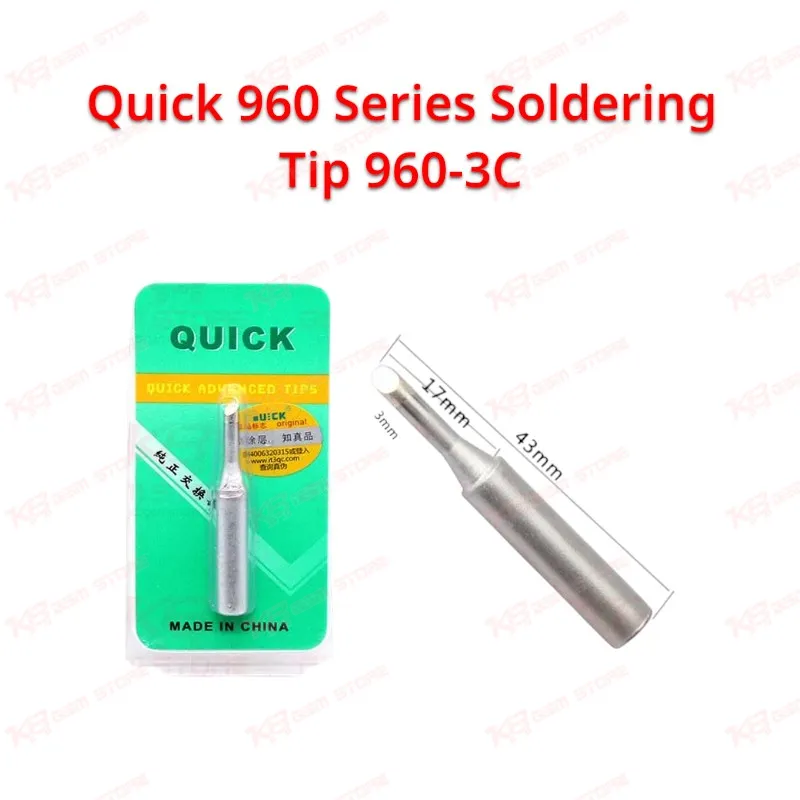
Every technician who runs a Quick soldering station eventually needs a dependable set of spare tips, and the Quick 960-3C fills that role for general-purpose board work. It belongs to the 960 (Q-T) series, the same tip family Quick uses across most of its mid-range and professional-grade soldering irons, so once you own a handle from this series you can standardize your tip inventory around it instead of hunting for odd sizes from different manufacturers. The 960-3C carries a straight body with a 45° bevelled edge and a 3mm working width, a shape that gives you more surface contact than a pointed tip when you're tinning larger pads, soldering thicker wires, or reworking connector pins on a phone or laptop board. That extra contact area helps heat transfer faster into the joint, which matters when you're working through a stack of boards during a busy shift at the workshop. You get a tip that handles both quick tack soldering and slower, more deliberate rework without needing to switch tools mid-job. Compatibility is straightforward: the 960-3C mounts directly onto Quick soldering iron handles like the 901RAA, 907A, 907D, and TSS30A, and it works with Quick stations including the 236, 706W, 706W+, 936A, 3102, 3104, and TS1100, along with other equipment built around the 960 (Q-T) tip series. If your station already uses 960-series tips, this one drops in without adapters or modification, so you're not stuck ordering a proprietary part that only fits one specific model. On a typical repair bench, this tip earns its place doing the unglamorous but constant work that keeps a shop running: reattaching connectors after a charging port replacement, soldering jumper wires after a board-level hardware fault, tacking down shields, repairing broken traces, and general component-level rework where a fine 1C or 0.5mm tip would be overkill. Technicians dealing with a dead phone after a failed flash, or a board pulled apart for a network issue diagnosis, often reach for a bevelled tip like this one when the job involves anything wider than a single fine-pitch IC pad. It's also a practical choice for training benches and service centers that need a tip durable enough to survive daily use across multiple repair jobs rather than delicate work reserved for microscopy-level rework. Because it's an original Quick part rather than a generic clone, the plating and core construction are matched to what your handle expects, which matters for even heat distribution and tip longevity. Cheaper aftermarket tips often oxidize faster or lose their plating within weeks of daily use, forcing you to replace them constantly and adding to your running repair costs. Keeping a couple of 960-3C tips in your toolbox means you're never stuck mid-repair waiting on a replacement to arrive, and swapping between a fine tip and this bevelled one takes seconds so you can match the tool to the job rather than compromising on precision or speed. For any workshop running Quick equipment, this tip is a straightforward, low-cost addition that covers the general soldering work you'll do every single day.