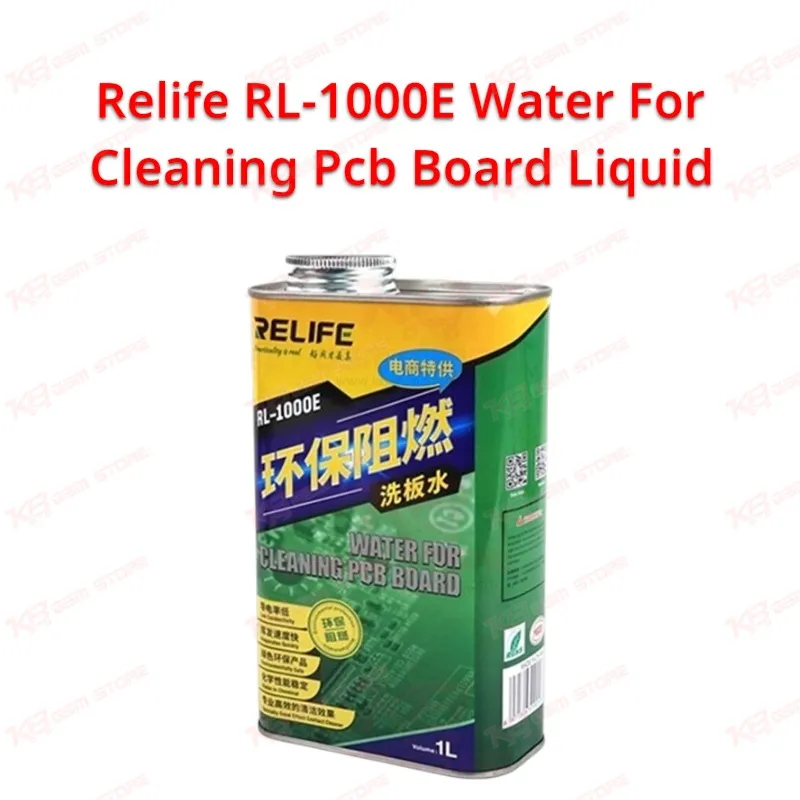
Every technician who has opened a dead phone after water damage knows the problem — corrosion sitting on the board, old flux baked around the ICs, and grease hiding the very points you need to probe. Relife RL-1000E is made to clear that mess without putting the board at more risk than it's already in. It's a water-based formula, so there's no strong smell, no flammability risk near your hot air station, and no worry about it eating through solder mask or component labels the way some harsher solvents do. You pour a small amount onto the board, brush gently around the ICs and connector pins, and watch oxidation, oil, and dust lift straight off. Because it's low conductivity, you don't have to fully power down and double-check every trace before testing — it dries clean and doesn't leave a conductive film that could short a board still under power. Fast volatilization is the other part that matters on a busy bench: you're not waiting around for the board to air dry before you move to diagnostics or reflow. That turnaround adds up when you're clearing a queue of phones with charging issues, hang on logo faults, or a dead phone after flash that turned out to be nothing more than a dirty connector. It also fits directly into an ultrasonic bath setup. Drop a heavily corroded board in, run a short cycle, and RL-1000E gets into the tight spots around BGA chips and under connectors that a brush alone can't reach — the kind of hardware fault cleanup that usually comes before a reballing job or an IC change. The liquid is built to be gentle on what's underneath it. It won't strip solder mask, won't discolor plastic housings, and won't leave streaks on glass or ceramic surfaces, so it works across more than just circuit boards — connectors, small metal brackets, and glass components on the same repair job can go through the same cleaning step. That versatility is why it shows up on benches doing everything from board-level chip work to general service center cleanup. Environmental protection was clearly part of the formulation too — it's non-toxic and safe to handle without gloves for short cleaning sessions, and it doesn't carry the fire risk that acetone or IPA-heavy cleaners bring when you're working near a hot air gun or soldering iron. For anyone running a service center in Pakistan, that safety margin matters when the liquid is sitting on a bench next to active soldering equipment all day. In practice, most technicians reach for RL-1000E at three points in a repair: right after opening a liquid-damaged device to strip corrosion before diagnostics, mid-repair to clean flux and solder paste residue after an IC change or jumper job, and as a final pass before reassembly to make sure no oil or dust is trapped under the shield or connector. It pairs naturally with an ultrasonic cleaner, a soft brush, and a hot air station in a standard PCB repair workflow, and because it evaporates fully without residue, it won't interfere with continuity testing or multimeter readings right after cleaning. For a shop processing water-damaged phones, tablets, or laptop boards regularly, this liquid becomes one of the basic consumables on the bench rather than a specialty item — cheap to run through in volume, safe around other tools, and reliable enough that board cleaning stops being a variable in your repair success rate.