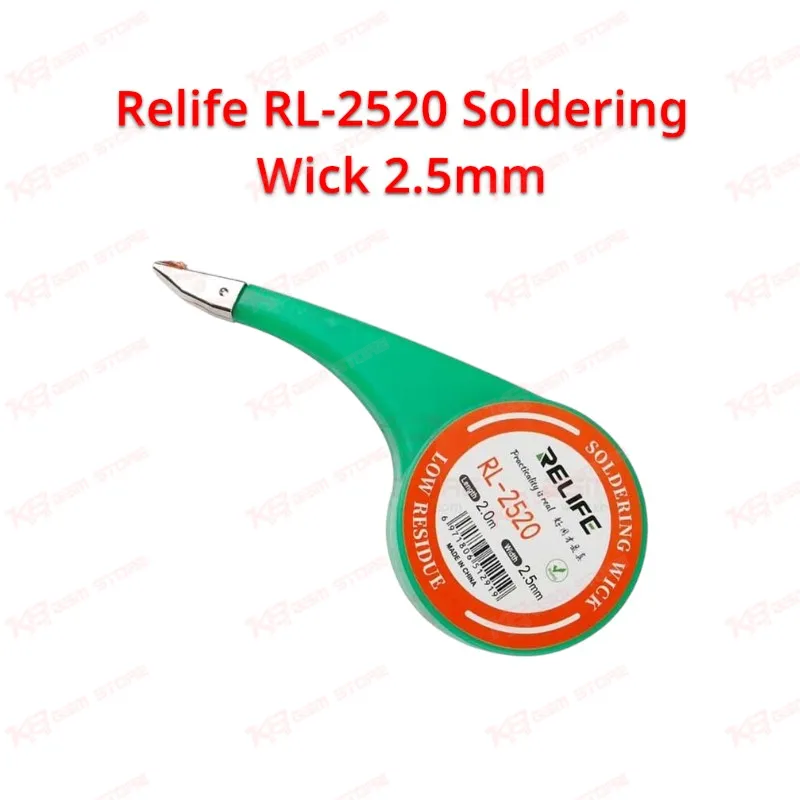
On a busy repair bench, a soldering wick that leaves behind sticky residue slows down every job that follows it, and that's exactly what the Relife RL-2520 fixes. Built with pure copper precision weaving, this 2.5mm wick draws molten solder off pads through strong capillary action, clearing excess tin from mobile mainboards, connectors, and PCBs without dragging pads or lifting traces. Technicians working on IC removal, connector desoldering, or general board cleanup get a wick that responds fast to heat, meaning the tip stays in contact with the joint for less time and nearby components face less thermal stress. The braid carries a no-clean, halide-free flux coating, so the residue left on the board is non-conductive and doesn't need a follow-up alcohol wipe before you move to reflow or the next repair step, a real time saver when you're running through several boards in a shift. Anti-corrosion and oxidation resistance keep the copper strands performing consistently, so the wick doesn't degrade sitting in a drawer between jobs, and the 2.0m length gives enough working material for multiple repairs before a refill is needed. The RL-2520 ships in a dispenser with a stainless steel mouth and a thumb-wheel feed, letting you pull out exactly the length you need and trim it without unraveling the coil, and the sealed housing keeps moisture away from the braid, which matters in humid workshop conditions where an exposed wick can lose absorption strength over time. On dead phone boards where a shorted IC needs to come off, the wick clears the solder pool around the pads first, giving you a clean surface for the hot air nozzle or soldering iron to finish the IC change karna step without extra tin interfering with reflow. For BGA rework, the fine 2.5mm width fits into tight pad spacing on mobile chipsets, letting you lift excess solder from around ICs before reballing without disturbing neighboring components. The ergonomic dispenser design makes the tool comfortable to hold at odd bench angles, which matters when you're working under a microscope for hours at a stretch. Beyond phone repair, the RL-2520 handles general PCB desoldering tasks: cleaning up bridged joints, removing excess solder from through-hole components, tidying connector pins before a replacement part goes in, and clearing pads during charging port or display connector repairs. Because the residue is low and non-conductive, boards stay safer from short-circuit risk after desoldering compared to wicks that leave heavier flux buildup. The 2.5mm width sits in the middle of Relife's wick range, wide enough to handle mainboard-level joints and connector pins while still being fine enough for tighter SMD work, which makes it a practical everyday pick for a repair shop that doesn't want to stock five different widths for routine jobs. Whether the task is a hardware fault on a customer's device or bench-level PCB assembly cleanup, this wick gives technicians a dependable, no-clean solution that keeps rework moving without adding cleaning time to every job.