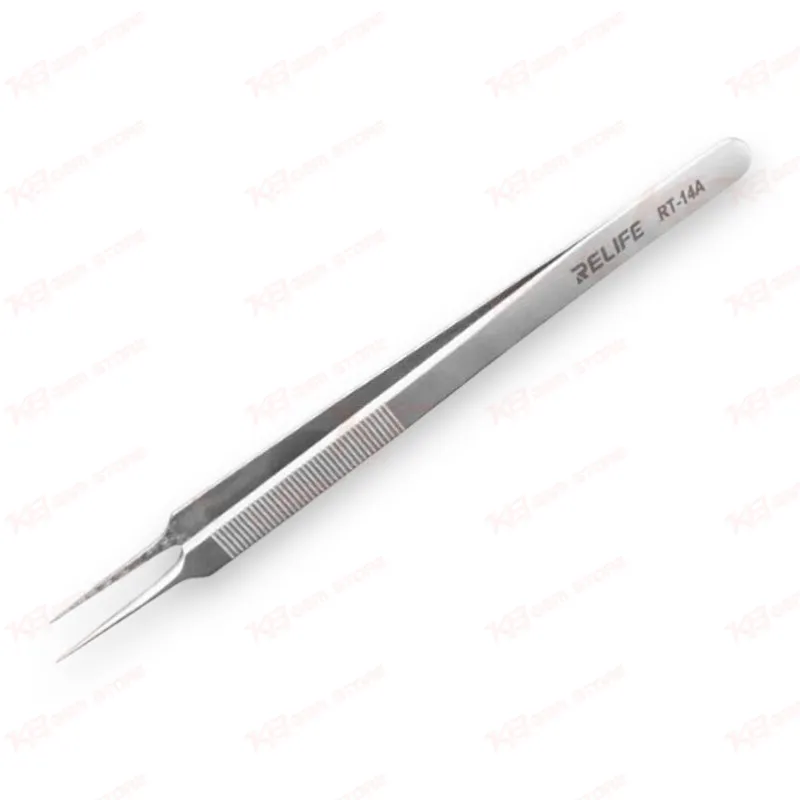
When a board comes in with a dead phone fault, hang on logo, or a suspected hardware fault, the first tool you reach for often decides how clean the repair turns out, and that's exactly where the Relife RT-14A Tweezers earn their place on a technician's bench. Built with a straight tip rather than a curved profile, this tweezer gives you a direct line of approach into tightly packed motherboard layouts, which matters when you're working around a chipset, a row of capacitors, or a jump wire path that has no room for a wide swing. The body is made from high-quality anti-magnetic stainless steel, so it won't interfere with sensitive components or pick up stray magnetic charge while you're handling ICs near a microscope. Anti-static, ESD-safe construction is the part that actually protects your repair, since a single static discharge from an ungrounded tool can silently damage a board that looked fine seconds earlier — with the RT-14A, that risk drops out of the equation. The tip itself is hand-finished, not machine-stamped, which is why it holds a tight, even bite on small parts instead of letting a chip rock or slide mid-placement; you feel that difference the moment you're repositioning a BGA pad or trying to lift a stubborn IC without lifting the pad along with it. An anti-glare surface finish cuts down eye strain across long sessions under bench lighting or a microscope lamp, something technicians doing back-to-back board jobs notice by the third or fourth hour of a shift. On the corrosion side, the stainless build resists rust and wear from repeated exposure to flux, alcohol cleaning, and everyday handling, so the tip geometry stays consistent instead of degrading after a few months of daily use. In terms of where it fits your workflow, this tweezer sits at the diagnostics and rework stage of mobile repair — after you've identified a boot loop issue or charging problem through software checks, the RT-14A becomes the physical tool that lets you act on that diagnosis, whether that's isolating a shorted component, guiding a jumper wire into place, or supporting an IC during reballing. It pairs naturally with a hot air station for reflow work, a soldering iron for jump wire tasks, and a microscope for the fine visual work that straight tweezers are suited to, making it a logical addition alongside ISP pinout tools, eMMC programmers, and reballing kits already on a technician's bench. The slip-resistant grip keeps control steady even when your hands are working at speed, which reduces the chance of a tip slipping onto an adjacent pad and creating a fresh short on a board you were trying to fix. For repair shops and service centers handling volume work, that kind of consistency across dozens of boards a day is what separates a tool that lasts from one that needs replacing every few weeks. The Relife RT-14A Tweezers don't try to be a multi-purpose gadget — they do one job, gripping and positioning small components on live electronic work, and they do it with the precision, static protection, and durability that a professional repair bench actually depends on.