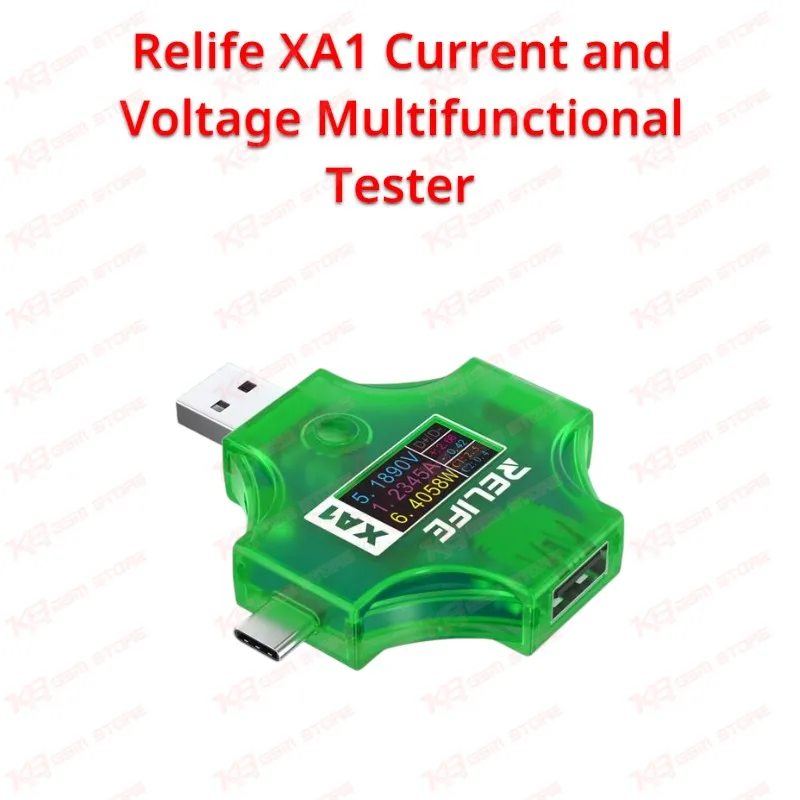
Charging complaints are one of the most common repair tickets that land on a Pakistani service center bench, and separating a bad adapter from a faulty cable or a phone-side charging IC fault wastes time without the right diagnostic tool. The RELIFE XA1 Current and Voltage Multifunctional Tester solves this by giving you live, on-screen readings of voltage, current, power, and accumulated capacity the moment a device is connected. The 160×80 DPI IPS screen stays readable under workshop lighting, and a one-click flip function rotates the display orientation so you can read values from either side of the bench without repositioning the tool. Voltage measurement spans 4V to 25V with 0.01V resolution, current reads up to 5A with 0.01A resolution, and both channels hold 1% measurement accuracy, which is tight enough to catch small deviations that point to a weak PMIC or a charging port with resistance. Beyond raw readings, the XA1 tracks energy and capacity statistics in Wh and Ah, letting you log how much power a charger actually delivers over a session rather than just a single snapshot. What separates the XA1 from a basic USB voltmeter is its protocol identification engine. It automatically recognizes PD, QC2.0, QC3.0, SCP, AP2.4A, and DCP fast-charging handshakes, so when a customer reports their phone is not fast-charging anymore, you can plug in and immediately see whether the adapter is even negotiating the correct protocol. If the tester shows a standard DCP handshake instead of the expected QC3.0 or PD negotiation, that narrows the fault to the charging IC or the cable's data lines rather than the wall adapter. The tool uses a specialized measurement chip capable of sampling both forward and reverse current, and the USB-C port itself can be plugged in either orientation — connect it to a charger to test output, or connect it inline with a phone to test draw, without worrying about which end is source and which is load. This bidirectional design is particularly useful on a busy repair bench where technicians are constantly swapping between testing incoming chargers and outgoing phone consumption. In day-to-day GSM workshop use, the XA1 becomes a first-step diagnostic before opening a device. Before you commit to a board-level repair on a dead phone or a hang-on-logo unit, checking whether the phone is drawing any current at all — and how much — tells you whether the fault is a dead battery, a blown charging IC, or a genuine hardware fault deeper in the board. It also earns its place in cable and charger quality control, letting shops verify that the adapters and data cables they stock or sell actually deliver rated output instead of underpowered or mislabeled units. At only around 20.5g and sized at 67×62×12mm, the XA1 fits easily into a technician's tool pouch or bench drawer alongside other diagnostic instruments like multimeters and test boxes, making it a practical addition for anyone doing charging port repair, battery diagnostics, or cable and adapter verification as part of their regular workflow.