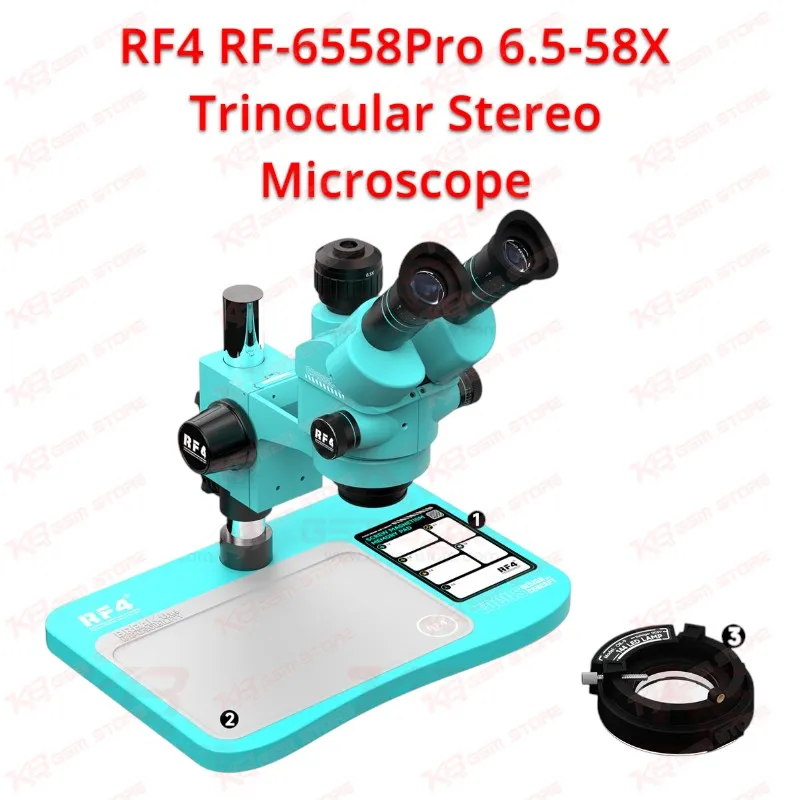
Every technician who has changed a charging IC or reballed a CPU knows that the microscope decides whether a repair succeeds, and the RF4 RF-6558Pro 6.5-58X Trinocular Stereo Microscope gives you the optics and the bench space to work with confidence. The zoom runs continuously from 6.5X to 58X, so you start at low power to locate a burnt track on a dead phone board, then dial up to read tiny solder joints without swapping objectives. The objective covers 0.65X to 5.8X and pairs with adjustable WF10X/22mm wide-angle eyepieces. That wide field lets you see the whole IC and the components around it at once, which saves you from hunting across the board while you rework. The trinocular head sits at 45 degrees and swivels 360 degrees, so you can turn the eyepieces toward your seat, or toward a colleague, without moving the board or the base. A metal zoom knob gives you firm, repeatable adjustment across long shifts. The camera connector uses a 0.5X CTV adapter, and it synchronizes the monitor zoom with the eyepiece zoom. When you turn the knob, the screen and your eyes stay at the same magnification, so nothing goes out of frame mid-repair. You can connect an HDMI camera and show a customer the exact fault, record a jumper lagana job for training, or teach a new apprentice how a reballing pass looks at 40X. The big base measures 380x260mm and gives you room for a PCB holder, a hot air station nozzle, and a tweezer set without crowding the stage. The stand offers 50mm of lifting range, a 155mm center distance, a lens aperture of 76mm, and a support column that holds the head steady while you work. You also get a 144 LED ring light for even illumination on shiny solder and dark boards, a dustproof lens, a limit lock, a leak-proof eyecup, a silicone pad, and a screw pad that keeps loose screws from rolling off your bench. Even lighting matters more than most shops admit. Shadows hide cold joints and bridged pins, and a ring light removes those shadows so you spot the fault before you heat the board. The silicone pad protects boards from scratches and heat, and the screw pad keeps small parts in order when you open a phone for a hardware fault. Pakistani repair shops handle a wide range of jobs on one bench, and this microscope covers most of them. A charging issue on a Samsung, Oppo, Vivo, Infinix, or Tecno board usually points to a small charging IC or a damaged pad, and you need magnification to confirm it. A phone that hangs on logo after a fall often has a cracked joint under the CPU or eMMC, and you see that crack under the RF-6558Pro before you commit to a reflow. Display problems, network issues, and no-power faults all start with a visual check of coils, capacitors, and connector pins, and the wide field speeds that check up. If your workflow includes dead after flash cases where you jump to ISP or eMMC work, the microscope helps you find tiny test points and confirm your wire contacts before you power the board. When you remove an IC, you pair the microscope with your hot air station and soldering station, check the pad condition after removal, clean the pads, and inspect them again before you place the new part. For reballing, you use it to confirm stencil alignment and ball placement before you heat the chip with your reballing kit. The RF4 RF-6558Pro gives you the same benefit at each step. You see more, you guess less, and you avoid lifting a pad or shorting a neighboring component. Repair shop owners will also value the trinocular design. A single microscope can serve your senior technician at the eyepieces and your front desk or training room on a monitor. You can record before and after images for your customer, document a tricky board for later, or train staff on real boards instead of pictures. Institutes that teach mobile repair use the same setup to show a class what a proper solder joint looks like. The build uses an all-metal camera adapter, with an aluminum alloy body and a chrome-plated bayonet, so it holds up under daily use in a busy workshop. If you compare it with a basic binocular microscope, the difference shows up in three places. You get a camera port when you need one, a bigger base when your bench fills up, and a zoom range that goes high enough for fine-pitch BGA inspection. If you plan to upgrade your bench, place this microscope beside your multimeter, test box, ISP pinout tools, eMMC programmer, UFS adapter, and PCB holder, and you build a complete IC-level repair station. Start with the microscope, because everything else you do on a board depends on seeing it clearly. Pick the RF4 RF-6558Pro 6.5-58X Trinocular Stereo Microscope if you want a dependable stereo microscope with a big base, a wide field, a synchronized camera connector, and a full accessory kit that suits daily mobile repair and PCB inspection work in Pakistan.