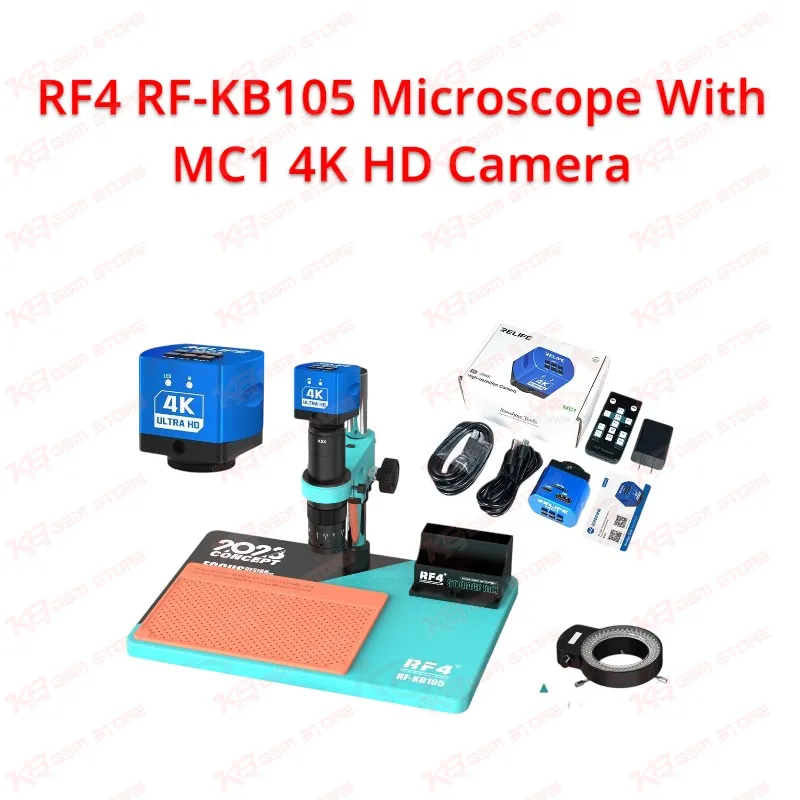
Every mobile repair workshop hits a point where the naked eye stops being enough — hairline PCB tracks, chipped pads, and fine-pitch IC legs only become visible under real magnification. The RF4 RF-KB105 is built for exactly that gap. It's a 7-45X optical monocular microscope that takes you from full board view down to IC-level detail, and the base is large enough (260 x 375mm) that you can scan an entire phone motherboard or laptop board without repositioning it every few minutes. The first thing you'll notice on your bench is the lighting. The RF-KB105 comes with a 144 LED ring light that throws even light around the component from every side, so you don't get shadow lines hiding fine solder joints, lifted pads, or micro-cracks that normal bench lighting misses. The LED intensity is adjustable, so whether you're working on a dark PCB or a reflective shiny surface, you can control the glare instead of fighting it. Now for the camera side. This unit runs on the RELIFE MC1 4K HD camera, built around a Sony 1/2.7-inch CMOS sensor. That sensor gives you good sensitivity, meaning the image stays clean even in lower light — useful during microsoldering when you're working close to a hot air gun and the lighting around you keeps shifting. The camera outputs 60-megapixel still images and 4K video at 30fps, both available through HDMI or Type-C, so you can mirror the feed onto any monitor or laptop screen. This is especially useful in shops where a senior technician is training juniors — you can walk them through exactly which angle to approach an IC change from, or where to place a jumper, with everyone watching the same live feed instead of crowding around one eyepiece. It also works well when a customer wants proof of a board-level fault — showing them the actual damage on screen builds trust and cuts down on disputes. The camera body weighs around 120g, so it stays light and easy to adjust with one hand. It uses a standard C-mount interface, which means it isn't locked to the RF-KB105 body alone — it also fits other industrial-grade trinocular or monocular microscopes that take a standard C-mount. In terms of actual repair workflow, this setup fits into almost every stage. At the diagnostics stage, you zoom in to check for burnt components, corrosion, or physical board damage before touching anything. During IC removal or reballing, precise placement depends on magnification — a small misalignment is enough to fail a BGA reballing job. During soldering and rework, the live camera feed lets you confirm a joint is properly formed in real time, without pulling your eye away from the eyepiece to double-check. It also earns its place on cases like charging port repair, display flex issues, network IC faults, and "dead after flash" boards — most of these come down to a tiny short or a dry joint that's invisible without magnification. RF4 is a well-established name in the mobile repair tools space, and the RF-KB105 sits in their entry-to-mid-range monocular lineup, built for daily repair shop use rather than lab-grade research work. If most of your bench time goes into phone motherboard, charging IC, and display flex level repair, this optical zoom and 4K camera combination is a solid permanent fixture for your setup. Overall, it's a good fit for shops looking to improve diagnosis accuracy, standardize technician training, and build customer trust through screen-based proof of the actual fault.