


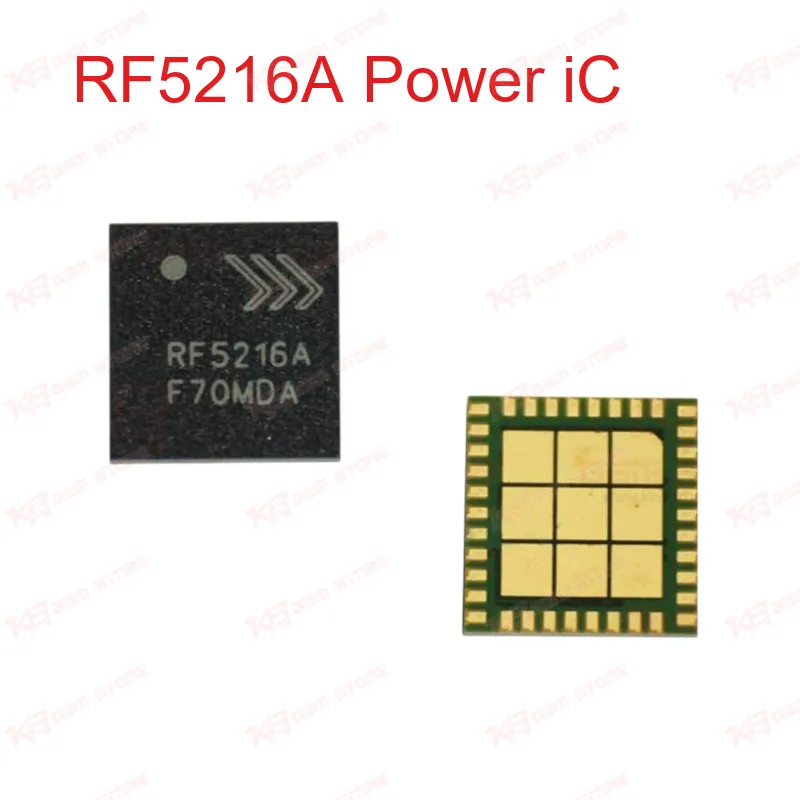
RF5216A Power iC
RF5216A Power iC
Regular price
Rs.150.00 PKR
Regular price
Sale price
Rs.150.00 PKR
Shipping calculated at checkout.
Quantity
Couldn't load pickup availability
RF5216A Power Amplifier IC is a genuine repair-grade PA chip used to fix network and signal faults on Xiaomi Redmi Note 3, Redmi Note 3S, Redmi 4, Redmi 4A, and Vivo Y85 motherboards. Technicians rely on this IC when a phone shows no network, weak signal, or dead network after a drop or short circuit. It restores the RF power amplification stage that controls signal transmission strength. Compact SMD package, direct board-level replacement, and commonly stocked alongside RF5422, RF5410, and RF7196D as alternate options for the same repair. Suitable for professional GSM repair benches and service centers across Pakistan.
⚖️ Weight: 0.01 kg
SKU:MST-IC-363
- Safe & Secure Payment
- Fast Delivery
- WhatsApp Support


Description
FAQ
What is the product name?
The product name is RF5216A Power Amplifier IC.
What is the model of this product?
The model is RF5216A.
What category does this product belong to?
It is a Power Amplifier (PA) IC used for RF signal amplification.
What is this product used for?
It is used to repair no-network, no-service, and weak-signal faults on the motherboard.
Which devices are compatible with this product?
It is compatible with Xiaomi Redmi Note 3, Redmi Note 3S, Redmi 4, Redmi 4A, and Vivo Y85.
Who should use this product?
This product is suitable for mobile repair technicians, repair shops, service centers, and professional users.
Can RF5216A be replaced with RF5422 or RF5410 on the same board?
Yes, on Redmi Note 3/4 series boards, RF5216A, RF5422, RF5410, RF5418, and RF7196D belong to the same functional family and are used interchangeably depending on the board revision fitted.
Does replacing RF5216A fix a "no network after drop" issue on Redmi Note 3?
In most cases yes, since this IC handles the RF power amplification stage — but the antenna connector and RF switch should be checked first if the network issue continues after reflow.