


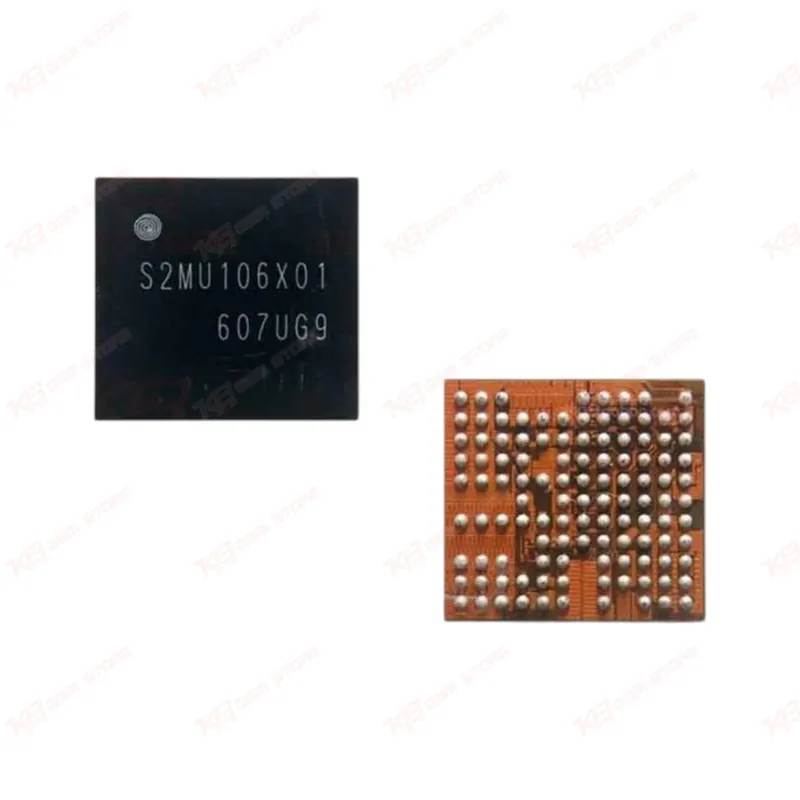
S2MU106X01 Power IC
S2MU106X01 Power IC
Regular price
Rs.1,500.00 PKR
Regular price
Sale price
Rs.1,500.00 PKR
Shipping calculated at checkout.
Quantity
Couldn't load pickup availability
The S2MU106X01 is a Samsung power management IC that handles charging and voltage regulation on the motherboard. Technicians use it to fix dead phone, no-charging, and dead-after-flash cases on Samsung Galaxy A and S10 series boards. This SMD-package voltage regulator operates on a 1.5–5V range with 0.5W power dissipation, matching OEM board specifications. You get a direct board-level replacement, not a generic substitute, so your repair holds up under real workshop conditions. Ideal for GSM technicians running IC-level diagnostics, reballing stations, and Samsung charging line repairs on a daily basis.
⚖️ Weight: 0.01 kg
SKU:MST-IC-65
- Safe & Secure Payment
- Fast Delivery
- WhatsApp Support


Description
FAQ
What is the product name?
The product name is S2MU106X01 Power IC.
What is the brand of this product?
The brand of this product is Samsung.
What is the model of this product?
The model of this product is S2MU106X01.
What is this product used for?
This product regulates voltage and manages the charging circuit on supported Samsung motherboards.
Which devices are compatible with this product?
This product is compatible with Samsung Galaxy A10, A30, A50, A70, A205, A305, A307, A315, A405, A715, M515, S10, S10e, S10+, S10 5G, and S10 Lite.
Who should use this product?
This product is suitable for mobile repair technicians, repair shops, service centers, and professional users.
Does this IC fix a dead-after-flash Samsung phone?
If the dead-after-flash symptom traces back to the charging or power regulation circuit, replacing this IC resolves the fault; a broader board-level short needs separate diagnosis.
What input and output voltage range does this IC support?
This IC operates across a 1.5V to 5V input and output range with 0.5W power dissipation, matching the original board specification.