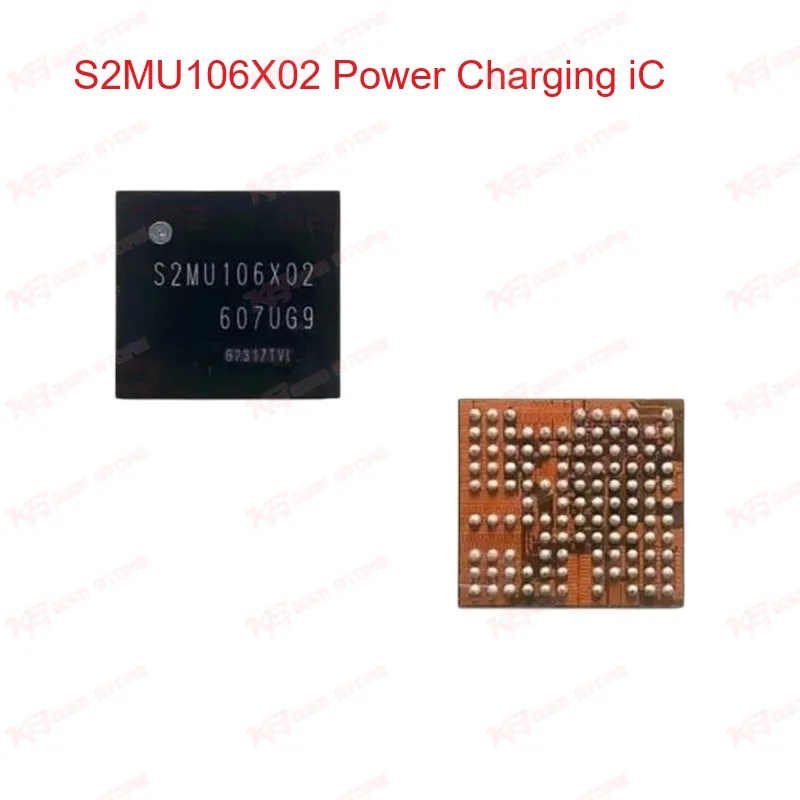
Charging faults on Samsung Galaxy boards rarely trace back to a bad charging port alone. When a phone shows dead after flash symptoms, charges intermittently, or stops registering the adapter altogether, the fault often sits on the S2MU106X02 power charging IC itself. This chip manages the charging path between the USB-C port, battery, and the board's main power system on Galaxy S20, A31, and A315 boards, making it one of the first components a technician checks during a charging issue diagnosis. You get a direct replacement part here, not a generic substitute pulled from an unrelated board. When a customer brings in a phone with a "not charging" or "slow charging" complaint and your multimeter readings point to the charging IC rather than the port or battery, this component gets the board back to normal charging behavior. Many repair jobs on these Samsung models involve board-level shorts or corrosion damage near the charging circuit, and replacing this IC restores the power delivery path without needing a full board swap. Your repair workflow with this part starts at diagnostics. Test the charging port continuity and battery health first, since a genuine IC fault shows consistent symptoms even after those components check out fine. Once you isolate the fault to the power charging IC, remove the damaged chip using a hot air rework station set to the correct temperature profile for BGA components, clean the pads thoroughly, and reball or replace with this new S2MU106X02 unit. Precise thermal control during removal and reinstallation matters here, since overheating the surrounding area risks damaging adjacent components on a densely packed board. This IC sits within the broader charging and power management subsystem alongside the main PMIC, battery fuel gauge, and USB-C connector. Technicians working on Samsung boards regularly encounter this chip during liquid damage recovery, since charging circuits sit close to the charging port and take the brunt of corrosion damage. A board that shows no response to any charger, fluctuating charge percentages, or a phone that only charges when the cable sits at a specific angle often points back to a failing or corroded charging IC rather than a cable or port problem. Reballing this chip requires a stencil matched to its ball grid layout and a controlled preheat and reflow cycle to avoid cold joints. Technicians running high repair volumes keep several of these ICs in stock given how frequently Galaxy S20, A31, and A315 boards come in with charging complaints tied to liquid exposure or drop damage. Pairing this part with a reliable microscope for pad inspection before reballing reduces the chance of a failed repair from misaligned balls or residual flux contamination. Board-level IC work on this scale separates a shop that handles component-level repairs from one limited to screen and battery swaps. Stocking verified charging ICs like the S2MU106X02 lets your bench take on jobs that would otherwise get sent out or rejected, and it builds a reputation for handling Samsung power and charging faults that other shops turn away. Pair this component with your existing hot air rework and reballing kit inventory to keep charging IC repairs moving without delays waiting on parts. Always confirm the exact board revision and IC marking under a microscope before ordering or installing, since Samsung PMIC and charging IC variants across similar model years can carry different markings despite visual similarity. A mismatched IC installed on the wrong board revision causes new faults rather than fixing the original charging problem, so pad-level verification against the removed chip protects your repair time and customer trust.