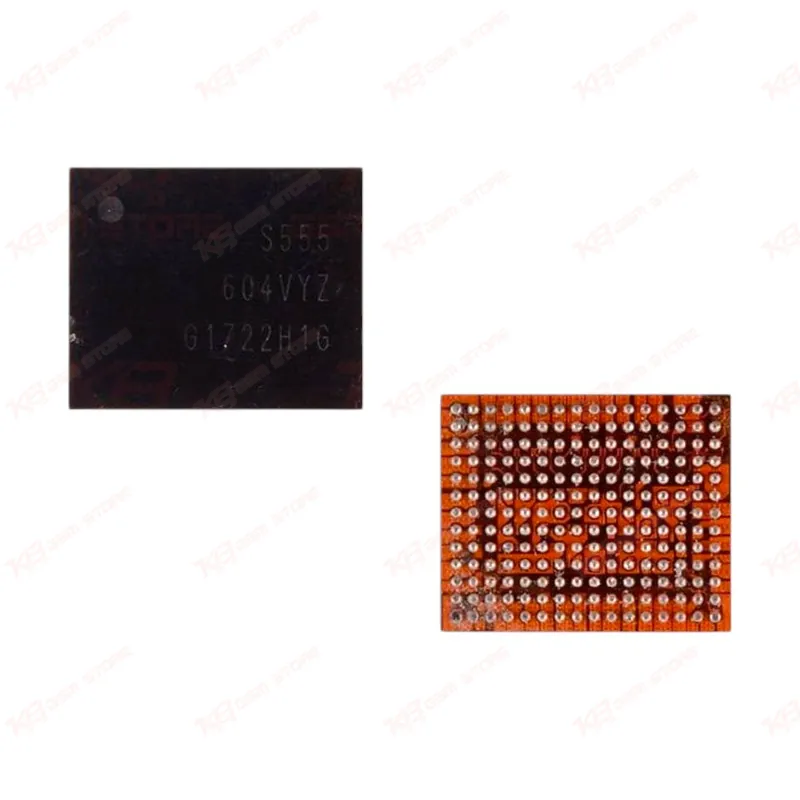
Every Samsung board built on the S7 platform runs its power distribution through a dedicated PMIC, and the S555 is that chip on the G930FD. It sits between the battery, the PMU rail, and the rest of the board, deciding how power gets split, stepped down, and delivered to the CPU, RAM, and display driver. When this IC degrades — usually from a short elsewhere on the board, liquid exposure, or a bad reflow — the phone stops behaving like it should, and the symptoms point straight back to the power section. On the bench, a failing S555 shows up in a few recognisable ways. The phone won't power on at all. It draws current on your power supply but never boots — a classic dead phone case. Sometimes it hangs on logo and never gets past the boot screen, or the board charges but won't turn on, which technicians usually log as a straightforward charging issue rather than a battery fault. Before you commit to an IC change, confirm the fault sits on the power rail and not somewhere downstream — check for shorts on the main power line first, since reballing a good IC onto a shorted board wastes both the part and your time. Replacing the S555 follows the same workflow you'd use for any BGA-level power IC: isolate the board, confirm the short or dead-IC diagnosis with a bench power supply and thermal camera or diode mode check, remove the old chip with hot air, clean the pads, reball with the correct ball size, and reflow the new S555 back onto its original footprint. Jumper lagana isn't usually needed here since the IC uses standard pads, but board cleaning before reflow matters more than most technicians give it credit for — flux residue under a power IC is a common cause of repeat failures. The S555 belongs to a small family of interchangeable power ICs used across Samsung boards — S535, S515, S518, S525, and S537 show up on related board revisions, and suppliers often list them together because they share a footprint and general function even where firmware or board revision determines the exact match. Confirm the board revision before swapping in a substitute from this family; a physically compatible IC isn't automatically the correct part number for every G930FD variant in circulation. This is a hardware fault repair, not a software marna job — flashing won't fix a dead or shorted power IC, and running software tools on a board with a bad PMIC usually just wastes a flash cycle. Once the new IC is seated and the board powers up cleanly on your bench supply without current spikes, you're clear to reassemble and test normally. For a repair shop working steady Samsung volume, keeping a few S555 units on hand alongside the rest of the S5xx family covers a recurring category of dead-board and no-power complaints without waiting on a special order mid-repair.