


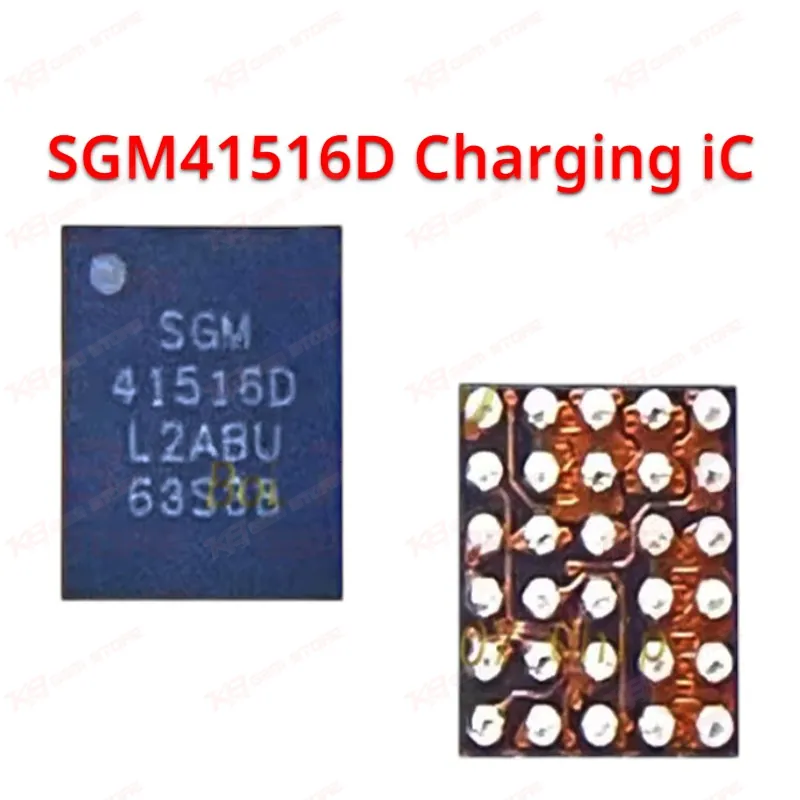
SGM41516D Charging iC
SGM41516D Charging iC
Regular price
Rs.300.00 PKR
Regular price
Sale price
Rs.300.00 PKR
Shipping calculated at checkout.
Quantity
Couldn't load pickup availability
The SGM41516D is a high input voltage, single-cell battery charger IC built with NVDC power path management, commonly used in smartphone charging circuits. Rated for 3.78A charging current, this IC handles fast charging, dynamic power management, and USB 2.0/3.0 compliant input regulation. Technicians dealing with charging issues, dead-after-flash boards, or IC change repairs on modern smartphone motherboards rely on this chip for restoring proper power path function. I2C programmable control gives it flexibility across multiple board designs, making it a core replacement part on any repair bench handling charging faults.
⚖️ Weight: 0.01 kg
SKU:MST-IC-340
- Safe & Secure Payment
- Fast Delivery
- WhatsApp Support


Description
FAQ
What is the product name?
The product name is SGM41516D Charging IC.
What is the brand of this product?
The brand of this product is SG Micro Corp (SGMICRO).
What is the model of this product?
The model of this product is SGM41516D.
What is this product used for?
This product is used for battery charging control and power path management on smartphone motherboards, including replacement during charging fault repairs.
Which devices are compatible with this product?
This product is used in Xiaomi, Oppo, Vivo, Realme, Infinix, Tecno, and Huawei smartphone boards that use this charger IC in their power circuit.
Who should use this product?
This product is suitable for mobile repair technicians, repair shops, service centers, and professional users.
Does this IC support OTG for connected accessories?
Yes, the SGM41516D supports USB OTG and can boost battery voltage to supply 5.15V on VBUS with up to 1.2A current limit.
Can this IC cause boot loop if faulty?
A faulty SGM41516D can cause boot loop on battery power while the phone still runs normally on direct USB power, since it controls the system-to-battery power path.