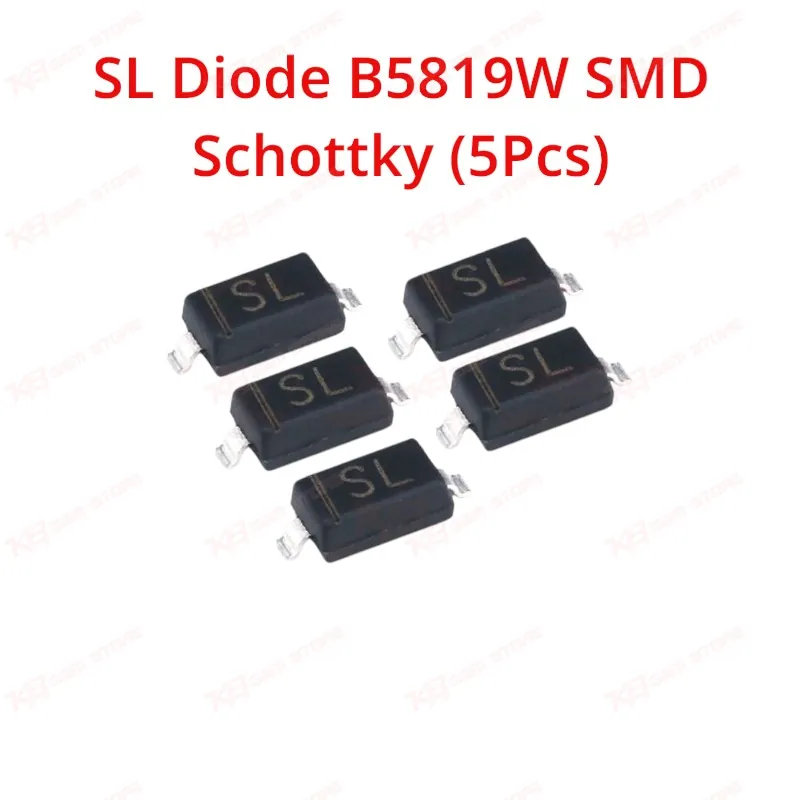
When you pull up a schematic and find an SL-marked diode sitting on a power or charging line, you are looking at a B5819W. This is one of the most commonly replaced components on mobile phone boards, and stocking a verified, correctly marked replacement saves you from guesswork during board-level repair.The B5819W is a Schottky barrier rectifier built in the SOD-123 surface mount package. Schottky diodes switch faster than standard silicon diodes and drop less voltage across the junction, which matters when you are repairing a line that carries charging current or feeds a protection circuit. This part carries a maximum forward voltage drop of 0.60V at 1A, so it does not eat into your board's power budget the way a generic diode would.On your bench, this diode handles a repetitive peak reverse voltage of 40V and a forward current of 1A continuously. It also tolerates a peak forward surge current of 9A for 8.3ms, which covers the momentary current spikes you see when a board powers on or when you are testing a repaired line under load. Power dissipation sits at 500mW, in line with what you expect from a SOD-123 footprint.You will most often reach for this diode when a board comes in dead or with a charging issue traced back to a shorted or open diode on the power path. Boards that hang on logo after a bad charging event, or show a hardware fault on the power rail during multimeter testing, frequently point back to a failed Schottky diode in this exact package. Since the SL marking is specific to the B5819W, you confirm the part before you desolder anything — mismatched replacements cause repeat visits and unhappy customers.Installation stays straightforward. The SOD-123 footprint matches the original pad layout on most phone boards, so you do not need to modify traces or adjust your soldering iron tip size beyond what you already use for SMD rework. Matte tin-plated terminals solder cleanly with standard hot air stations and fine-tip irons, and the "Green" molding compound body carries a UL 94V-0 flammability rating, so it holds up under repeated reflow without degrading.This component fits into board-level and PCB repair workflows rather than software-side fixes. You use it for power line protection, charging circuit repair, and general board-level diode replacement where the schematic calls for a 40V/1A Schottky part in a SOD-123 case. It also works in low-voltage, high-frequency circuits and free-wheeling or polarity-protection applications, which covers most of the situations where you would find this marking on a consumer device board.Because this diode ships as a generic, JEDEC-style part number, multiple certified semiconductor manufacturers produce B5819W units carrying the SL marking. What stays consistent across manufacturers is the electrical rating: 40V reverse voltage, 1A forward current, and the SOD-123 outline. That consistency is why the SL marking, not a specific brand name, is what you check against your schematic.Buying this as a 5-piece pack keeps your bench stocked for more than one job. Diodes in this category get damaged during desoldering more often than most passive components, since the small SOD-123 body heats up fast and cools unevenly if you rush the joint. Having spares on hand means a slipped iron or a lifted pad does not stop your repair mid-job.Store these in an ESD-safe container alongside your other SMD stock, and keep them separated by marking code if you carry multiple SOD-123 diode types — SL, SK, and SJ markings look similar at a glance under a microscope, but they carry different voltage and current ratings. Confirming the marking before you solder protects your repair from a repeat failure.