


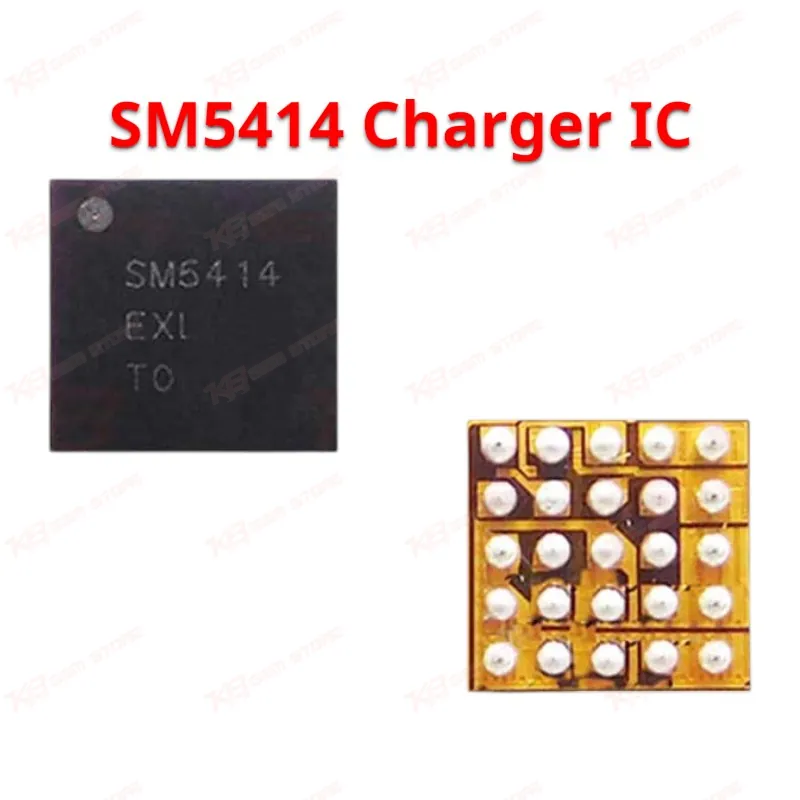
SM5414 Charger IC
SM5414 Charger IC
Regular price
Rs.200.00 PKR
Regular price
Sale price
Rs.200.00 PKR
Shipping calculated at checkout.
Quantity
Couldn't load pickup availability
The SM5414 charging IC comes from Silicon Mitus and manages power on Android motherboards built around switching-charger, dual-path circuitry. You reach for this chip when a board shows a charging issue, a dead phone symptom, or won't power up after you've already checked the charging line with a jumper. It handles up to 2.5A fast charge current, runs a 1.5MHz synchronous switching regulator, and communicates with the board over a 400kHz I2C interface. Boost mode delivers 5.0V to 5.2V programmable OTG output at 900mA. On your repair bench, this IC replaces failed or shorted charging chips on OPPO and Meizu boards carrying the SM5414 socket.
⚖️ Weight: 0.01 kg
SKU:MST-IC-137
- Safe & Secure Payment
- Fast Delivery
- WhatsApp Support


Description
FAQ
What is the product name?
The product name is SM5414 Charging IC.
What is the brand of this product?
The brand of this product is Silicon Mitus.
What is the model of this product?
The model of this product is SM5414.
What is this product used for?
This product is used for managing battery charging and power-path switching on Android smartphone motherboards, replacing faulty charging ICs.
Which devices are compatible with this product?
This product is compatible with Android motherboards built around the SM5414 charging IC socket, most commonly found on OPPO and Meizu boards.
Who should use this product?
This product is suitable for mobile repair technicians, repair shops, service centers, and professional users.
Does the SM5414 support USB OTG boost output?
Yes, the SM5414 runs a boost mode for USB OTG with a programmable output of 5.0V to 5.2V at up to 900mA.
What is the maximum charge current the SM5414 supports?
The SM5414 supports up to 2.5A fast charge current through its synchronous switching regulator.