


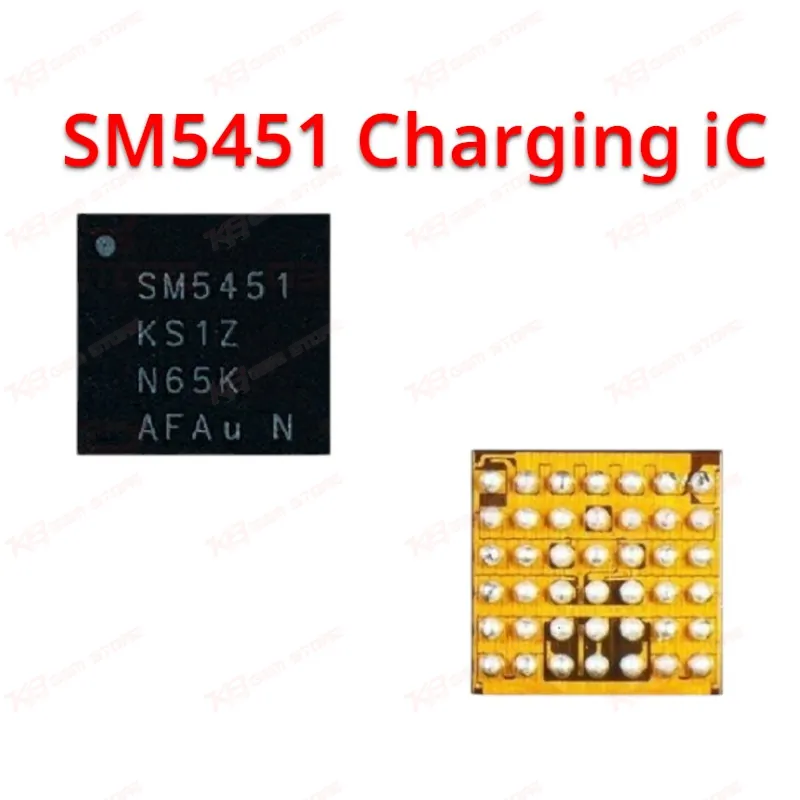
SM5451 Charging iC
SM5451 Charging iC
Regular price
Rs.350.00 PKR
Regular price
Sale price
Rs.350.00 PKR
Shipping calculated at checkout.
Quantity
Couldn't load pickup availability
The SM5451 is an original switched capacitor charging IC used in Samsung smartphones to control fast charging, voltage regulation, and current protection. Jab phone charging nahi le raha ho ya charging slow chal rahi ho after checking the board, is IC ka fault common reason hota hai. Manufactured by Silicon Mitus, this chip handles high-efficiency power delivery between the charging port and battery management circuit. Technicians use it as a direct replacement when a dead or damaged charging IC is diagnosed on Samsung motherboards, restoring normal charging behavior without touching unrelated power rails.
⚖️ Weight: 0.01 kg
SKU:MST-IC-351
- Safe & Secure Payment
- Fast Delivery
- WhatsApp Support


Description
FAQ
What is the product name?
The product name is SM5451 Charging IC.
What is the brand of this product?
The brand of this product is Silicon Mitus.
What is the model of this product?
The model of this product is SM5451.
What is this product used for?
This product is used for controlling and regulating fast charging current between the charging port and battery on supported Samsung boards.
Which devices are compatible with this product?
This product is compatible with Samsung smartphone models that use the SM5451 in their charging circuit (verify against original board markings).
Who should use this product?
This product is suitable for mobile repair technicians, repair shops, service centers, and professional users.
Does this IC support fast charging above normal 5V/2A rates?
Yes, it supports up to 6A charging current in 2:1 forward mode, enabling fast-charging beyond standard rates.
Can this IC be repaired with a jumper instead of full replacement?
No, due to the 42-bump WLCSP package with fine pitch spacing, direct reballing or replacement is required rather than jumper wiring.