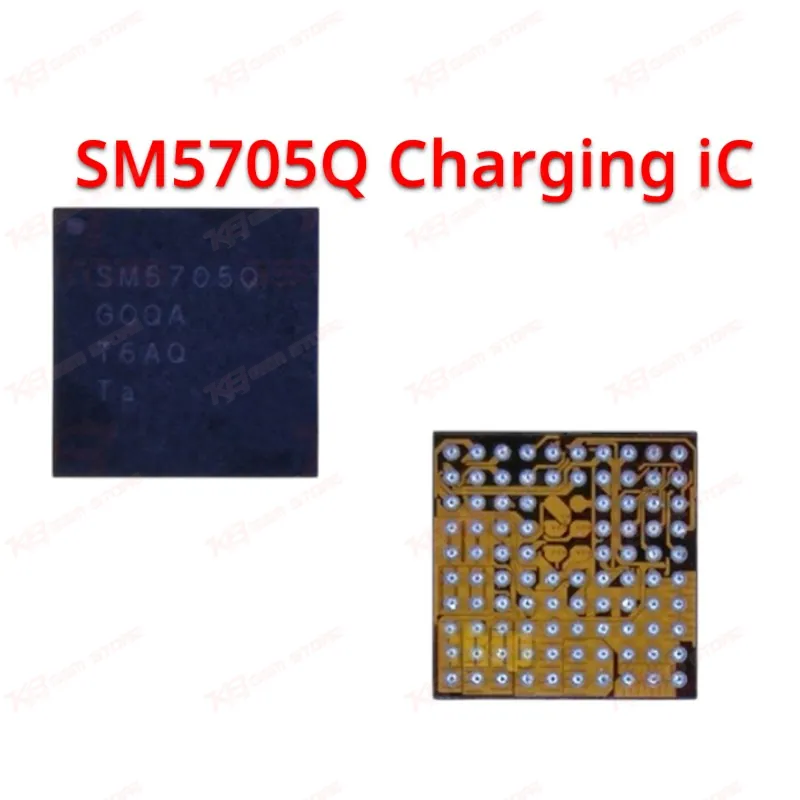
Charging faults on Samsung Galaxy A-series and J-series boards trace back to the SM5705Q more often than technicians expect. When a phone shows "charging paused," draws current but doesn't fill the battery, or refuses to charge at all after a liquid damage or power surge, this IC is one of the first components you check on the board. It sits directly in the charging path between the USB connector and the power management circuit, so a damaged unit blocks charging current before it even reaches the battery.The SM5705Q works as a charging and power path controller. It regulates the input current coming from the charger or USB cable, manages the charge rate going into the battery, and reports charging status back to the phone's power management IC. On the Samsung A5 (2016), A7 (2016), A3 (2016), C5, C7, and J5 (J500F) boards, this chip carries almost the entire charging workflow on its own, which is why a single fault here shows up as a complete charging failure rather than a partial one.You install this IC using BGA rework methods. Remove the damaged chip with a hot air station set to the correct temperature profile, clean the pads on the board with flux and a soldering iron tip, reball the new chip if it doesn't come pre-balled, then reflow it back onto the board using a microscope for alignment. Skipping the cleaning step or misaligning the ball grid causes cold joints, and cold joints on a charging IC show up later as intermittent charging — the phone works fine on the bench, then drops charging again after a few days in the customer's hand. Precision at the soldering stage decides whether the repair holds.Common symptoms this IC resolves: phone shows charging icon but battery percentage doesn't move, phone charges only when the cable is held at a specific angle, phone doesn't charge at all despite a working cable and adapter, charging LED doesn't turn on, or the phone gets warm near the charging port without gaining any charge. Before you commit to a chip swap, rule out a faulty charging port, damaged flex cable, and a bad battery — these three fail far more often than the IC itself and cost less to replace. Once the port, cable, and battery test clean and the fault still points to charging control on the board, the SM5705Q swap is your next step.This chip also comes up during board-level liquid damage repair. Corrosion around the charging IC footprint is common on these boards after water exposure, since the USB port sits close to it. If you're already cleaning corrosion with isopropyl alcohol and a brush, check this IC's pads closely under the microscope — hairline corrosion between balls causes exactly the same "no charging" symptom as a fully dead chip, so a reflow alone sometimes fixes it without a full replacement.For a Pakistani repair shop or mobile service center, stocking this IC saves you from board-swap repairs on a phone series that's still common in the used and refurbished market. A full motherboard costs far more than the chip and forces you to transfer IMEI-linked components, which adds risk and time. A targeted IC replacement keeps the original board intact, keeps the repair cost fair for the customer, and turns around faster on a busy bench. Stock a few pieces if you handle A5/A7/J5 boards regularly, since charging faults on these models are a recurring workshop job rather than a rare one.