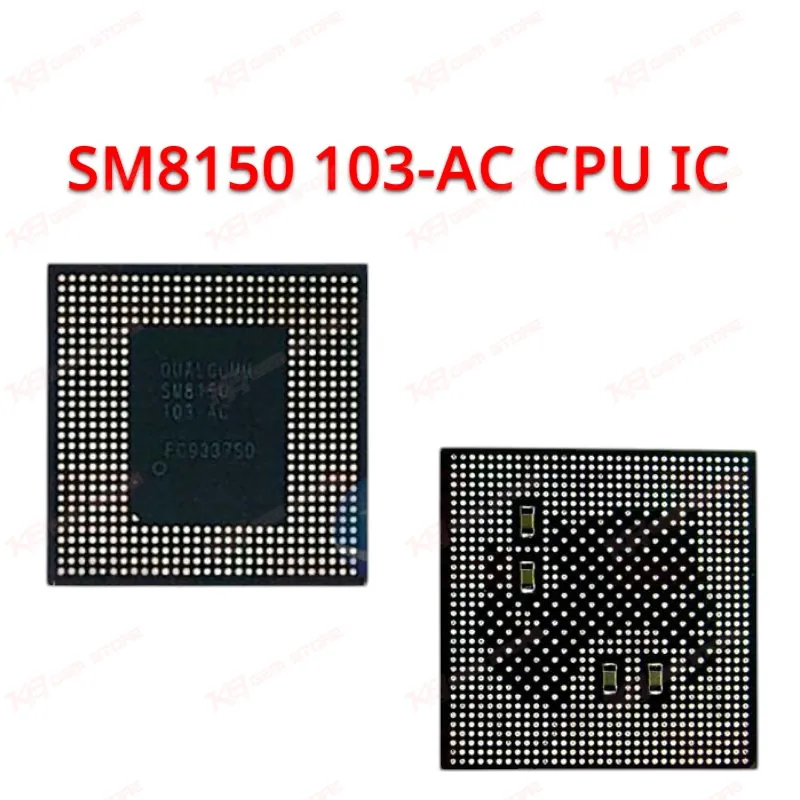
Board-level repair work on flagship 2019-era Android devices regularly brings the Snapdragon 855+ chipset to your bench, and the Qualcomm SM8150 103-AC is the exact CPU IC behind that chipset. This part number identifies the Snapdragon 855+ variant specifically — a slightly overclocked version of the standard SM8150 (Snapdragon 855), so getting the correct part number right matters before you commit to a CPU change on any board.The SM8150-AC uses a 7nm fabrication process and packs an octa-core Kryo 485 CPU arrangement: four performance cores built on ARM Cortex-A76 architecture (one running up to 2.96GHz, three up to 2.42GHz) paired with four efficiency cores based on Cortex-A55 running up to 1.8GHz. Graphics processing runs through the Adreno 640 GPU. The chip also integrates a Hexagon 690 DSP and supports LPDDR4x memory, which means it talks directly to the RAM chip during boot and normal operation.For a technician, this matters because a faulty SM8150-AC produces symptoms that overlap with several other board faults — dead phone with no display, hang on logo, sudden shutdown under load, or boot loop that survives a software flash. Before jumping to CPU reballing, always rule out PMIC faults, RAM dry joints, and power rail shorts first, since CPU-related failures on this chipset are less common than PMIC or charging IC failures but do occur after liquid damage, physical board stress, or previous reflow mistakes by another shop.When you do confirm a CPU fault — through current draw testing, boot logs on a compatible box, or elimination of other components — replacing the SM8150-AC requires proper BGA rework equipment. A calibrated hot air station with accurate temperature control, a CPU-specific reballing stencil matched to the SM8150 ball pattern, quality solder balls, and flux rated for lead-free reflow are all part of the job. Preheating the board evenly before removal reduces the risk of pad lifting, which is the most common reason CPU change jobs fail on high-layer-count flagship boards like these.This IC sits at the center of the mobile repair workflow for any Snapdragon 855+ device: it works alongside the PMIC for power sequencing, the RAM/UFS storage for boot data, and the modem section for network function. A software marna approach alone won't fix a genuine CPU fault — if the board doesn't respond to a UFI or similar flashing box after ruling out storage and power issues, CPU-level hardware fault becomes the likely cause.Stocking genuine, tested SM8150 103-AC units on your repair bench means you're not waiting on sourcing when a customer brings in a dead OnePlus 7T or a Black Shark 2 Pro with a confirmed CPU fault. Always verify the exact part marking under magnification before removal and reballing, since Qualcomm chipset variants (AA, AC, AD) look nearly identical but are not interchangeable.For repair shops and service centers handling flagship-tier boards regularly, having this IC on hand alongside your reballing stencils and hot air station keeps CPU-level jobs moving without downtime.