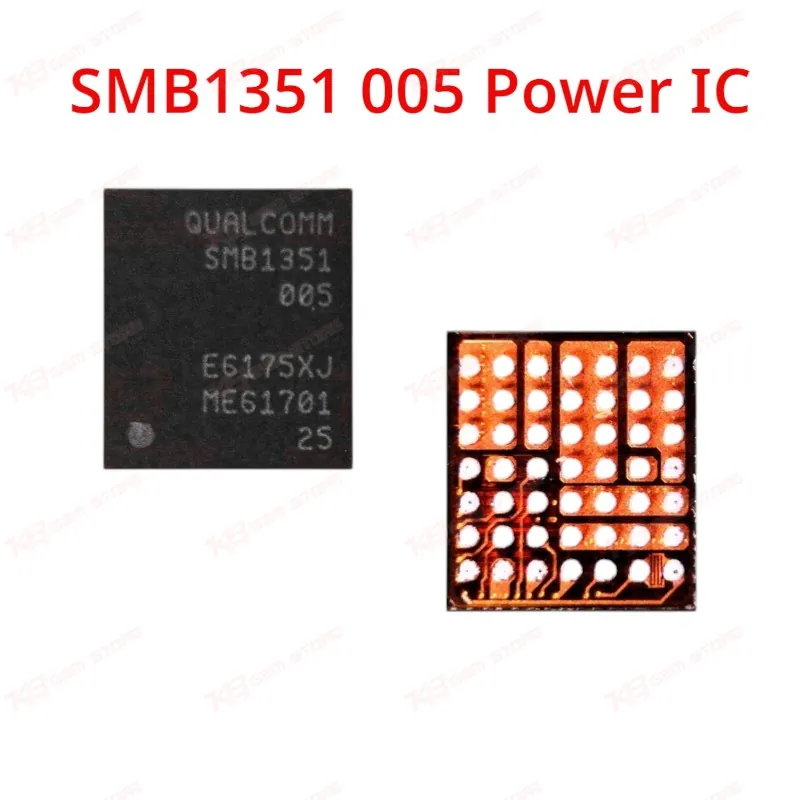
When a Xiaomi Mi 5 comes in with a charging issue, your first job is separating a battery fault from an IC fault. The SMB1351 005 Power IC sits right in that charging path, so it's usually one of the first components you test with a bench power supply and multimeter. This chip started life as a Summit Microelectronics part and now ships under the Qualcomm brand, built specifically as a programmable switch-mode battery charger for single-cell lithium-ion and lithium-polymer cells.On the Mi 5 board, this IC takes input from the USB connector and regulates it into safe, controlled charge current for the battery. It also handles Quick Charge 3.0 negotiation, so when a fast charger is plugged in, the SMB1351 005 manages the voltage step-up instead of dumping raw current straight into the cell. That's exactly why a failing unit gives you symptoms like charging LED on with no percentage increase, extremely slow charging on original chargers, or a phone that only charges intermittently when you wiggle the cable.You'll typically land on this IC after ruling out the charging port, flex cable, and battery itself. Put the board on your bench supply — if current draw stays flat or spikes without any corresponding charge behavior, and your board view under the microscope shows no lifted pads or shorted traces near the IC, reflow or replace the SMB1351 005 next. A lot of technicians in the field just call this the "charging IC" or "power IC" without knowing the exact part number, but once you've confirmed the symptom pattern, this is the chip doing the actual switch-mode regulation work.Reballing this part needs the same discipline as any BGA rework: clean the pad thoroughly, use fresh solder paste rather than reused balls, keep your hot air station at a controlled temperature to avoid lifting neighboring components, and always check continuity to ground and VBAT after placement. Skipping the cleaning step is the single biggest reason technicians see the same charging fault return within days.This IC doesn't touch your baseband, doesn't affect network signal, and won't cause boot loop or hang-on-logo symptoms — its job is isolated to power delivery and battery charge management. If you're seeing those other faults alongside a charging problem, you're likely dealing with a separate PMIC or baseband issue, not this chip.Stock one or two of these on your bench if you handle Xiaomi repairs regularly. Charging faults are among the most common walk-in complaints for the Mi 5, and having the correct part on hand means same-day turnaround instead of sending the board out or waiting on a supplier order. Pair it with a good soldering station and flux, and this becomes a straightforward, repeatable repair rather than a guessing game.