


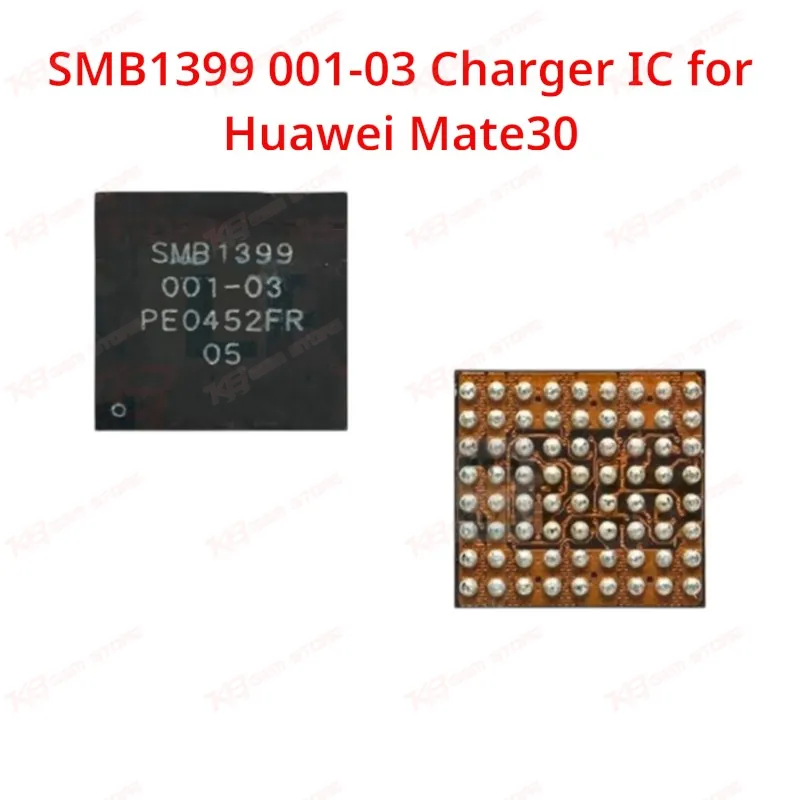
SMB1399 001-03 Charger IC for Huawei Mate30
SMB1399 001-03 Charger IC for Huawei Mate30
Regular price
Rs.350.00 PKR
Regular price
Sale price
Rs.350.00 PKR
Shipping calculated at checkout.
Quantity
Couldn't load pickup availability
The SMB1399 001-03 is a genuine Qualcomm power management IC used for charging repair on the Huawei Mate30. If your Mate30 shows no charging, slow charging, or charging drops after a liquid damage or board-level fault, this IC restores the charging path on the motherboard. Built on Qualcomm's PMIC architecture with I2C control and thermal protection, it handles the charging current safely without overheating your board during rework. Ideal for GSM technicians doing IC-level board repair, reballing, or charging fault diagnosis on Huawei Mate30 units at your repair bench.
⚖️ Weight: 0.01 kg
SKU:MST-IC-219
- Safe & Secure Payment
- Fast Delivery
- WhatsApp Support


Description
FAQ
What is the product name?
The product name is SMB1399 001-03 Charger IC for Huawei Mate30.
What is the brand of this product?
The brand of this product is Qualcomm.
What is the model of this product?
The model of this product is SMB1399 001-03.
What is this product used for?
This product is used for repairing charging faults on the Huawei Mate30, including dead charging ports, slow charging, and intermittent charging after liquid damage or board-level short circuits.
Which devices are compatible with this product?
This product is compatible with the Huawei Mate30.
Who should use this product?
This product is suitable for mobile repair technicians, GSM repair shops, service centers, and professional board-level repair specialists.
Does the SMB1399 001-03 require reballing or can it be soldered directly?
The SMB1399 001-03 comes in a fine-pitch WLCSP package and needs proper reballing with a matching stencil and hot air station for a reliable board-level connection.
Can a faulty SMB1399 001-03 cause a dead charging port without any physical port damage?
Yes, a shorted or degraded SMB1399 001-03 can produce a dead charging port or intermittent charging symptom even when the physical charging port and cable test fine, since the IC controls the current path between the port and the battery.