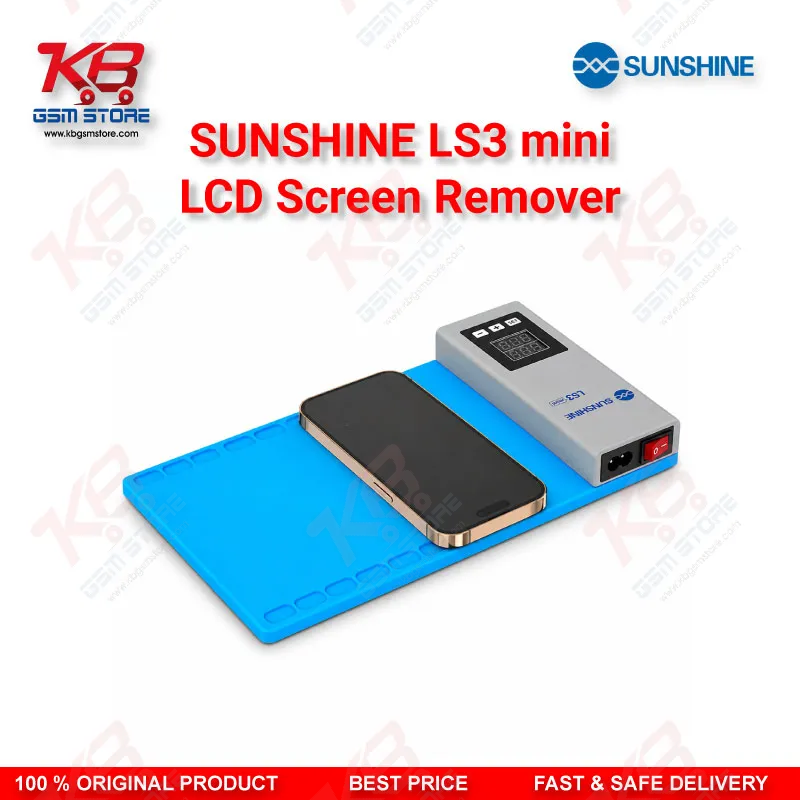
Every GSM workshop reaches a point where screen removal becomes the bottleneck. Cold blades and lighters scratch frames, damage flex cables, and waste time on jobs that should take minutes. The SUNSHINE LS3 Mini solves this with a dedicated heating platform designed specifically for separating LCD and OLED screens from mobile phones and tablets up to 10.5 inches, covering everything from small Android panels to larger tablet digitizers.
The core of the LS3 Mini is its rapid constant temperature heating system. Instead of a single fixed setting, you get a full adjustable range from 10°C to 130°C, controlled through an LED LCD display that shows both the actual surface temperature and your preset target in real time. This matters more than it sounds. Different adhesives release at different temperatures — a budget Infinix or Tecno panel with basic glue softens well below 100°C, while some OEM Samsung and iPhone units need higher, more consistent heat to break the seal cleanly. Guessing with a heat gun risks warping the frame or cracking the panel; setting an exact number on the LS3 Mini removes that guesswork and protects your yield rate.
Heat distribution is where a lot of cheaper separator pads fail. The LS3 Mini uses a double-layer high-temperature silicone mat that spreads heat evenly across the working surface instead of concentrating it in the center. That even spread is what actually protects the screen — hotspots are what cause glass to crack or digitizers to delaminate unevenly during a rushed repair. The silicone itself stays soft and non-deformable even after repeated heating cycles, so the mat keeps its shape job after job. It also flexes and rolls without cracking, which makes it easy to slide into a tool drawer or repair bag between benches.
Despite the compact footprint, the working area is generous enough for phone screens and tablets under 10.5 inches, so it handles the bulk of daily repair traffic without needing a second, bulkier machine on the bench. That's useful in a Karachi or Lahore service center where bench space is tight and technicians are handling mixed jobs — a cracked display today, a battery swap tomorrow, a charging issue the next hour.
In actual use, the workflow is straightforward. Power the unit from a 110V/220V supply, set your target temperature based on the device and adhesive type, and let the platform reach that constant heat. Once the surface hits temperature, place the phone or tablet screen-down on the mat for a short dwell time before working a pry tool or suction cup around the edge. Because the heat stays constant instead of spiking and dropping, you get a longer working window to separate the panel cleanly instead of racing against cooling glue. For technicians new to a specific device, starting at a lower temperature and increasing gradually is the safer approach until you know how that particular adhesive behaves.
This kind of heating separator sits early in the screen repair workflow — before digitizer replacement, before frame realignment, before reassembly. Getting this step right directly affects whether the rest of the repair goes smoothly. A screen removed with uneven or excessive heat often comes with a damaged flex cable or a warped frame, which turns a simple display problem into a longer, costlier repair. The LS3 Mini is built to prevent exactly that outcome on high-volume repair days.
At 120W power draw and roughly 447g in weight, it draws modest power for what it does and stays light enough to move between benches or take to an on-site job. The compact 147×285×34mm body doesn't demand a dedicated corner of the workshop the way larger vacuum separator machines do, making it a practical first heating tool for a shop just setting up a proper screen repair station, or a reliable backup unit for a shop that already runs a bigger machine.
For Pakistani repair shops handling steady volumes of iPhone, Samsung, Oppo, Vivo, and Tecno screen jobs, the LS3 Mini fills a specific gap: fast, controllable, even heat without the size or cost of a full vacuum separator system. It's a tool built around getting one job — clean screen separation — done consistently and safely, repair after repair.