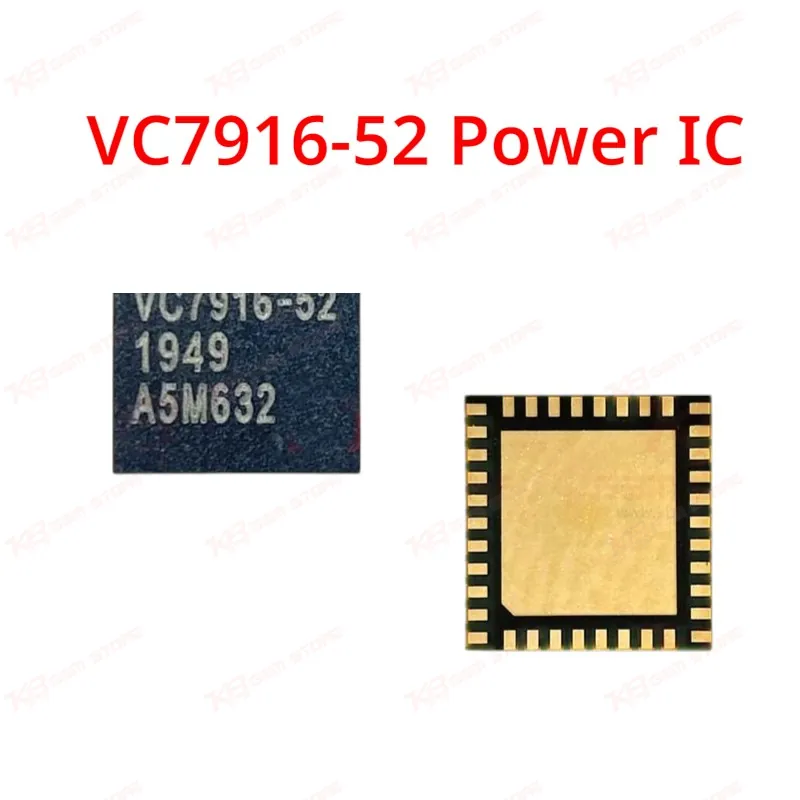
When a phone comes in with a dead network or signal that won't lock no matter what SIM you throw in it, the RF power amplifier is one of the first things you check on the board. The VC7916-52 fits that exact repair scenario. It's part of the VC7916 series developed by Vanchip, a chip family built around RF signal amplification for GSM, GPRS, EDGE, TD-SCDMA, and TD-LTE bands. On the bench, this translates to one job: boosting the transmit signal cleanly enough that the phone can actually talk to the tower.Board space matters when you're reworking a tightly packed motherboard, and this is where the VC7916-52 earns its place. The package measures roughly 5.5 x 5.3 x 0.83mm, small enough to sit close to other RF components without eating into layout you need for other fixes. Inside that footprint, the chip integrates its own antenna switch, so you're not chasing a separate switch IC on top of the PA when you're diagnosing a network issue. It communicates over a MIPI RFFE digital interface, which is standard across most modern RF front-ends, so integration with existing baseband setups on supported boards stays straightforward.ESD protection is rated at 8KV at the antenna port. That number matters more than it sounds — antenna-side components take repeated static exposure just from normal handling, charging cable insertion, and case removal in the field. A PA chip with weak ESD tolerance fails again within weeks of a repair, which is the last thing you want after reballing or hand-soldering a replacement. The VC7916-52's protection rating gives the repair some staying power instead of becoming a repeat customer complaint.In a typical repair workflow, this chip shows up after diagnostics point to RF front-end failure rather than a software or SIM tray issue. You'd usually rule out software marna style fixes first — flash the board, check IMEI, confirm the baseband is registering — before pulling the PA IC. Once you've confirmed the fault sits at the RF amplifier stage, IC removal and replacement with a verified VC7916-52 is the next step. Reflow with proper hot air control, check for pad damage, and confirm the swap under a microscope before reassembly, since a lifted pad on this footprint is easy to miss with the naked eye.This chip is genuinely useful for shops handling higher volumes of network-related complaints, where guessing at compatibility on antenna-switch-integrated PAs wastes both time and stock. For a workshop already running ISP and eMMC-level repair alongside RF work, keeping a stock of VC7916-52 alongside other IC families in the VC7916 line (such as VC7916-53 and VC7916-55) makes sense, since boards from the same production batches often carry different bin variants of the same base chip.As with any RF-stage IC swap, success depends on match confirmation against the specific board's schematic or a side-by-side comparison with the faulty chip before desoldering. This part is sold as a genuine component for direct chip-level replacement, not a universal fix for every network fault — pair it with proper diagnostics for the best outcome on your repair bench.