


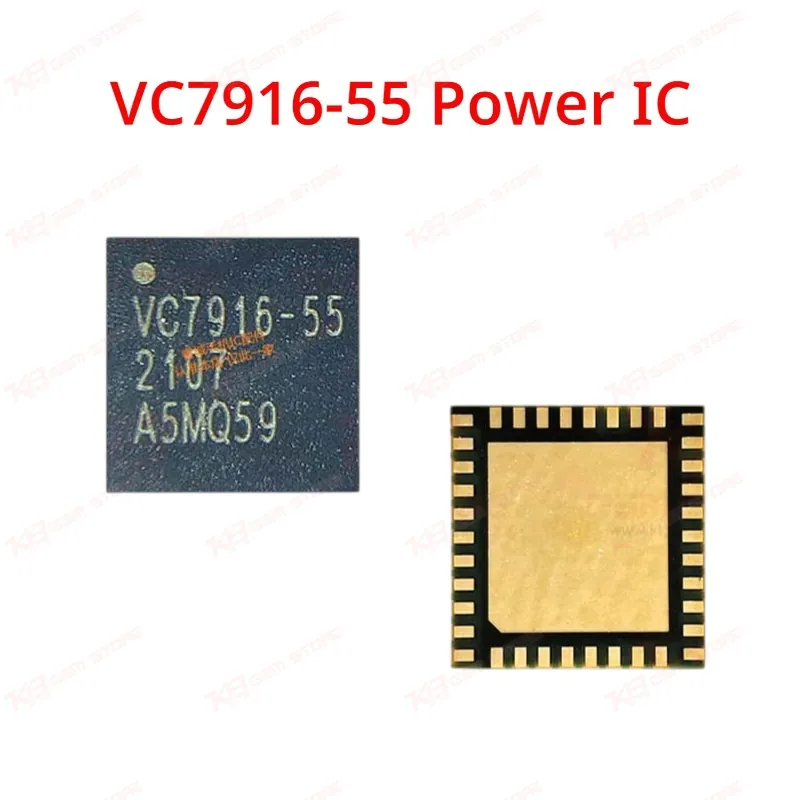
VC7916-55 Power IC
VC7916-55 Power IC
Regular price
Rs.300.00 PKR
Regular price
Sale price
Rs.300.00 PKR
Shipping calculated at checkout.
Quantity
Couldn't load pickup availability
VC7916-55 is a VANCHIP-manufactured RF power amplifier IC widely sold in Pakistan's mobile repair market as a "Power IC." It runs the RF front-end on Quad-Band GSM/GPRS/EDGE/TD-SCDMA/TD-LTE handsets, with an integrated SP16T antenna switch and MIPI RFFE digital control. Technicians reach for this chip when a board shows weak network, no service, auto-restart, heating near the RF section, or dead-after-flash symptoms. Confirmed for use in the Vivo Y21 (2021) and found across similar quad-band boards. KB GSM Store supplies a technician-tested unit ready for reballing and direct board-level replacement.
⚖️ Weight: 0.01 kg
SKU:MST-IC-237
- Safe & Secure Payment
- Fast Delivery
- WhatsApp Support


Description
FAQ
What is the product name?
The product name is VC7916-55 Power Amplifier IC.
What is the brand of this product?
The brand of this product is VANCHIP. What is the model of this product?
What is this product used for?
This IC runs the RF power amplification and antenna switching on quad-band GSM/GPRS/EDGE/TD-SCDMA/TD-LTE handsets, and technicians use it to fix network, signal, and RF-section related faults.
Which devices are compatible with this product?
Confirmed for the Vivo Y21 (2021) and commonly found on other Android boards using the same Quad-Band GSM/EDGE/TD-SCDMA/TD-LTE RF front-end architecture.
Check the board schematic for unlisted models. Who should use this product?
This product is suitable for mobile repair technicians, repair shops, service centers, and professional users.
Is VC7916-55 a power management IC or an RF chip?
It's an RF power amplifier IC with an integrated antenna switch, sold in the repair market under the "Power IC" name because of the auto-restart and heating symptoms linked to it.
Does VC7916-55 support MIPI RFFE control?
Yes, it uses a MIPI RFFE digital interface alongside its integrated SP16T antenna switch for RF front-end control.