


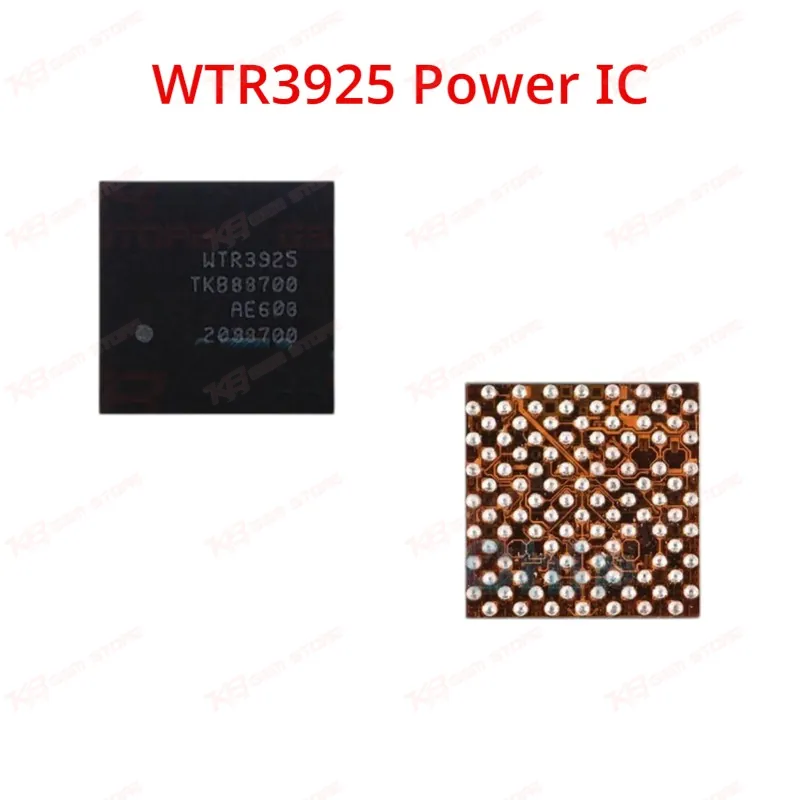
WTR3925 Power IC
WTR3925 Power IC
Regular price
Rs.200.00 PKR
Regular price
Sale price
Rs.200.00 PKR
Shipping calculated at checkout.
Quantity
Couldn't load pickup availability
The WTR3925 is a genuine Qualcomm RF transceiver IC used across Android and iPhone motherboards to handle network and signal processing. When a device shows no network, no service, or intermittent signal drops, this is the chip your repair bench needs to check first. It supports LTE and WCDMA bands and pairs directly with the phone's baseband and RF front-end. Built for board-level microsoldering, the WTR3925 restores stable network connectivity after liquid damage, ESD failure, or a bad reflow. A reliable pick for GSM technicians doing daily network-fault diagnostics.
⚖️ Weight: 0.01 kg
SKU:MST-IC-226
- Safe & Secure Payment
- Fast Delivery
- WhatsApp Support


Description
FAQ
What is the product name?
The product name is WTR3925 Network IC.
What is the brand of this product?
The brand of this product is Qualcomm.
What is the model of this product?
The model of this product is WTR3925.
What is this product used for?
This product is used for fixing no-network, no-service, and weak-signal faults on mobile phone motherboards.
Which devices are compatible with this product?
This product is compatible with iPhone 6S/6S Plus/7/7 Plus, Samsung Galaxy A6+, several Xiaomi Mi and Redmi models, Oppo A71, select Motorola boards, and the OnePlus 3T.
Who should use this product?
This product is suitable for mobile repair technicians, repair shops, service centers, and professional users.
Does the WTR3925 fix no-network or no-signal issues on Android phones?
Yes, it is the RF transceiver responsible for signal modulation between the baseband and RF front-end, and it is one of the first ICs technicians check when a board shows no service or dropped network.
Can the WTR3925 be reflowed with a hot air station, or does it need a dedicated BGA machine?
It can be reflowed with a hot air station if you control temperature and use a proper stencil, though a dedicated BGA rework machine gives more consistent results on dense boards.