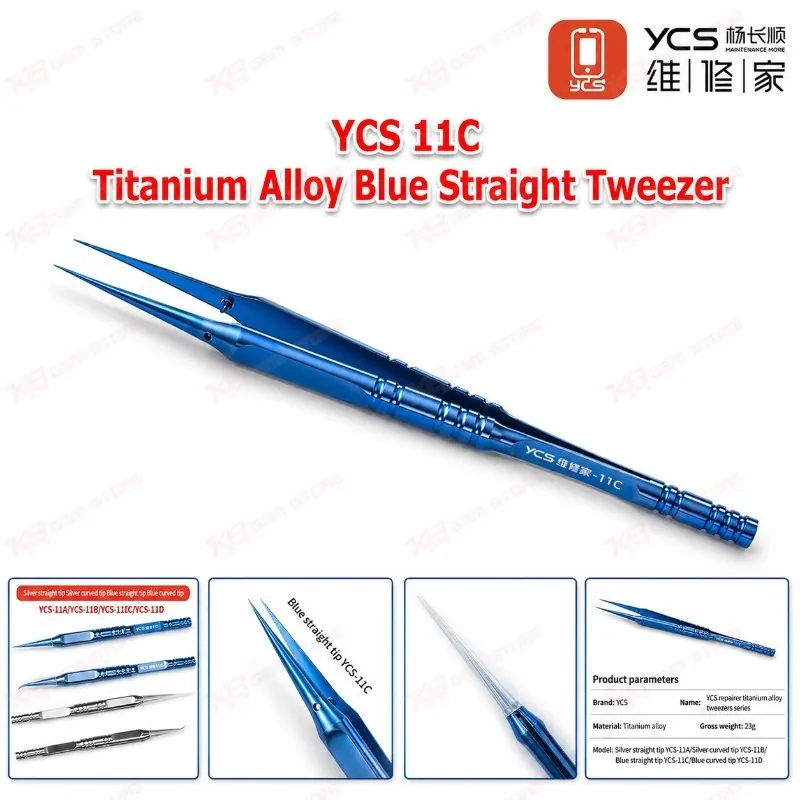
Every board-level technician knows the moment when a dead phone sits under the microscope, the shield is off, and one tiny capacitor beside the charging IC needs to move without disturbing anything around it. The YCS 11C Titanium Alloy Blue Straight Tweezer exists for exactly that moment, giving you a pair of straight, finely aligned tips that close evenly and hold small parts with real control. YCS offers the 11C as the blue-finish version of its straight-tip titanium tweezer, alongside the natural-finish 11A and the curved-tip 11B and 11D models in the same series, so you get the same sharp precision in a color that stands out on a cluttered repair bench. The straight profile suits work where you approach the component from directly above, such as placing resistors and capacitors back onto their pads, lifting a shifted filter after rework, or holding jumper wire flat along a trace while your soldering iron does its job. When the tips meet cleanly along their length, the part stays where you put it instead of flicking off across the board, and that saves you the frustrating search for a lost component on the mat. Titanium alloy is the main reason technicians move up from ordinary tweezers, and the 11C shows why. The material keeps the tool light at around 23g, so your fingers stay relaxed through a long jumper session or a full afternoon of SMD work. The alloy resists corrosion from flux residue, IPA, and the cleaning liquids that sit on every workbench through humid Pakistani summers, so the tips keep their finish month after month. Titanium is also a non-magnetic metal, which helps when you work near small screws, shields, and speaker parts that would otherwise jump toward a magnetized tool. The silicone safety cover deserves more credit than it usually gets. Fine tips bend or blunt when a tweezer drops into a drawer with screwdrivers and blades, and once a tip goes out of alignment the tool loses its precision. Snapping the cover on after each job protects the points and protects your hand when you reach into a busy tool tray. In daily shop work, the 11C earns its place across many common faults. On a charging issue, you use it to place a replacement capacitor near the charging IC or steady a connector pin while you reflow it. On a network issue, it helps you seat small RF components and filters after you lift the shield. On a boot loop issue or hang on logo case that traces back to a hardware fault, it lets you remove and reposition passives around the PMIC while you check lines with your multimeter. On display problem jobs, it handles small connector parts and backlight components with the same steady grip. The tweezer also fits naturally into a full bench workflow. Pair it with a hot air station for component removal, a soldering station for jumper wire and pad repair, a PCB holder to keep the board flat, and a stereo microscope so you can see the tips clearly at magnification. If you handle reballing, the straight tips help you position a stencil or nudge a chip into alignment on a reballing kit. Many technicians keep a straight and a curved tweezer side by side, so when your work needs a clearer view around tall components, the curved YCS 11D makes a sensible companion and a logical next tool for your bench. For shop owners checking YCS tweezer price in Pakistan, the 11C makes practical sense as a daily-use tool for every technician on the team, because its corrosion-resistant titanium build handles flux, cleaning liquids, and constant handling without losing its edge. Keep the cap on when you store it, wipe the tips with IPA after flux-heavy jobs, and never use it as a pry tool, and it will keep serving your repair bench for a long time.